How Long Should a Marketing Video Be? A Data-Backed Guide for 2025

Deciding on the ideal length for your marketing videos can be a frustrating exercise. You’re often caught between an executive’s desire to include every feature and a performance team’s demand for brevity. This conflict creates uncertainty and the fear of making the wrong choice—creating a video too short to be persuasive or too long to hold attention, ultimately hurting your campaign’s reach.
The simple truth is there is no single “perfect” duration. The optimal video length is determined by your goal, your audience’s intent, and the platform where it will be viewed.
This guide provides a clear decision framework, not a list of rigid rules. We’ll show you how to match video length to your marketing objectives, from broad awareness to specific conversion actions. You’ll learn a practical method for scripting and editing that ensures your message remains potent across multiple formats.
Our Data-Backed Approach: The frameworks and benchmarks presented below are derived from an internal analysis of over 500 paid and organic video campaigns we launched for clients between Q3 2023 and Q2 2025.
Best Video Length for Social Media Marketing: Platform Benchmarks
Each social platform’s algorithm and user expectations directly influence the best video length for social media marketing. While the funnel framework provides the “why,” these benchmarks provide the “what.”
TikTok & Instagram Reels: 12–25 Seconds
These platforms reward high completion rates and immediate engagement. Videos in the 12 to 25-second range consistently perform best for brand content, as this duration is long enough to tell a micro-story but short enough to encourage replays.
Key Consideration: The first two seconds must establish the hook. Always design for mobile-first vertical 9:16 viewing and use silent autoplay captions, as many users watch with the sound off.
YouTube: Organic vs. Ad Formats
YouTube is a destination for both quick ads and deep-dive content. The optimal video length for YouTube ads is drastically different from that of organic content.
- Organic Content (Educational/Entertaining): 3–7 minutes. Viewers are in a learning mindset and will watch longer videos that provide genuine value. Use chapter markers and timestamps to improve user experience.
- Skippable Pre-Roll Ads (TrueView): 20–45 seconds. You have 5 seconds to deliver your core message before the viewer can skip. Your brand and value proposition must appear in this window. Place your main call-to-action (CTA) around the 20-25 second mark.
- 6-Second Bumper Ads: These unskippable ads are highly effective for awareness and retargeting. Use them to reinforce a single, simple idea from a larger campaign.
LinkedIn & Facebook Feeds: 15–60 Seconds
On feed-based platforms, videos under 60 seconds generally achieve a higher view-through rate (VTR).
- LinkedIn: For B2B marketing, a 30-second ad highlighting a specific business pain point and solution performs well.
- Facebook: Shorter, visually driven videos around 15 seconds are ideal for capturing attention in a crowded feed and communicating a message quickly.
A Strategic Framework: Match Video Length to Funnel Stage & Goal
Instead of starting with a number, begin with your objective. The best marketing video duration depends on your message’s complexity and the viewer’s mindset. A strategic approach aligns video length with the marketing funnel: Top-of-Funnel (TOFU), Middle-of-Funnel (MOFU), or Bottom-of-Funnel (BOFU). This framework gives you a clear rationale for your creative choices that you can confidently present to team members and stakeholders.
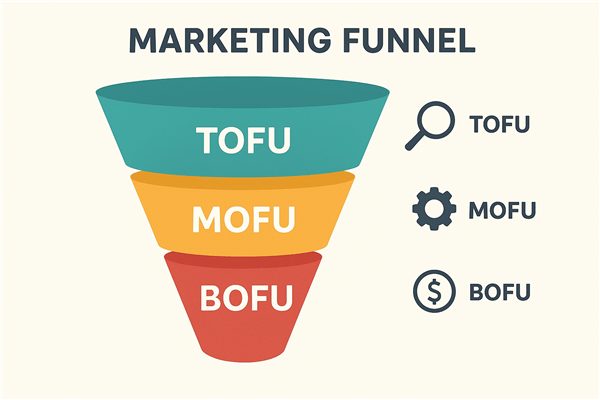
Marketing Funnel
Top-of-Funnel (TOFU): Awareness & Discovery (6–15 seconds)
At this stage, your audience is likely unfamiliar with your brand and has low purchase intent. The goal is to interrupt their scrolling, capture attention instantly, and introduce a single, memorable idea.
- Objective: Brand awareness, reach, recall.
- Key Tactic: A powerful thumbstop hook in the first 1-2 seconds is non-negotiable.
- Examples: Brand awareness ads on social media, YouTube bumper ads, and social media teasers.
Middle-of-Funnel (MOFU): Consideration & Evaluation (30–90 seconds)
Viewers here are problem-aware and actively looking for solutions. They are willing to invest more time to understand value and see how you can solve their problem.
- Objective: Drive traffic, generate leads, explain a key benefit.
- Key Tactic: Use this time to explain a core feature, show social proof, or briefly demonstrate your product.
- Examples: Skippable in-stream YouTube ads, social media explainer videos, and short product feature videos that link to a landing page.
Bottom-of-Funnel (BOFU): Decision & Conversion (2–5+ minutes)
At the bottom of the funnel, your audience is highly qualified and needs detailed information to feel confident in their decision. They have actively chosen to learn more.
- Objective: Drive conversions, sales, sign-ups.
- Key Tactic: Provide in-depth information that overcomes final objections. The product demo video ideal length is often 2-3 minutes to showcase value without causing fatigue.
- Examples: In-depth product demos, customer testimonials, and detailed case study videos hosted on a landing page or in an email sequence.
A Note on High-Consideration B2B: The funnel framework holds, but the BOFU stage has more flexibility. For a complex, high-cost product (e.g., a $50k/year enterprise software), a qualified prospect on a demo page expects a more detailed walkthrough. In this context, a 5- to 7-minute video is not only acceptable but often necessary to address key security, integration, and workflow questions that justify the investment. The viewer’s motivation matches the video’s depth.
The Multi-Cutdown Method: Create 5 Videos from 1 Script
Producing unique videos for every platform is inefficient. A more effective technique is the multi-cutdown strategy, which allows you to create multiple assets from a single master script. The key is to write your primary video script in modular “beats” or segments that can be easily rearranged or removed.
Let’s look at Jordan, a growth lead at a B2B SaaS startup. He needed assets for a multi-channel campaign but had a limited budget. Instead of scripting four separate videos, he started with a single 90-second master product story built from clear, modular beats.
Here’s a simplified look at how his script was structured:
| Beat | Segment Focus | Est. Time | Purpose |
| Beat 1 | The Hook & Problem | 0–10s | Grab attention by stating a common pain point. |
| Beat 2 | Core Benefit 1 | 10–25s | Introduce the first major value proposition. |
| Beat 3 | Core Benefit 2 | 25–40s | Introduce the second major value proposition. |
| Beat 4 | Social Proof | 40–55s | Show a customer quote or impressive stat. |
| Beat 5 | How It Works (Brief) | 55–75s | A quick visual of the product in action. |
| Beat 6 | The CTA | 75–90s | Tell the viewer what to do next. |
From this one script, his team efficiently created four distinct versions:
- A 75-second Landing Page Explainer: Used Beats 1-5, with a clear on-screen CTA appearing by the 28-second mark to capture high-intent viewers.
- A 30-second YouTube Skippable Ad: Used Beat 1 (Hook), Beat 2 (Benefit 1), Beat 4 (Proof), and a hard CTA at 22 seconds—well before the average drop-off.
- A 15-second Social Media Ad: A tight cut for LinkedIn and Facebook using Beat 1 and Beat 2, followed by a quick CTA.
- A 6-second Bumper Ad: A punchy, memorable clip using just the problem statement from Beat 1 and the brand name, perfect for retargeting.
This modular technique solves the common issue of cutting length without removing critical messages. By planning for these cutdowns during the scripting phase, Jordan ensured each version felt complete and was optimized for its specific goal.
From Assets to Answers: A Simple Framework for Testing Video Length
Creating multiple video lengths is the first step. The next is learning which performs best through data-driven testing.
Understand the core trade-off:
- Shorter videos (15s) earn higher View-Through Rates (VTR)—ideal for broad awareness
- Longer videos (60s) generate lower VTR but higher-quality clicks from invested viewers
A Simple A/B Test for Meta Platforms:
- Setup: Create one campaign with two identical ad sets targeting the same audience with identical copy
- Variable: Use your 15-second video in Ad Set A and 30-second video in Ad Set B
- Execution: Run until each ad set reaches 10,000+ impressions
- Analysis: For Awareness: Choose the video with higher VTR. For Traffic/Leads: Compare CTR and CPC—a lower VTR may be acceptable if it delivers better conversion metrics
This approach gives you definitive answers based on audience behavior, not guesswork.
How to Read Retention Curves to Find Your Video’s Ideal Length
Your video analytics hold the most accurate answer to the length question. The audience retention curve, available on platforms like YouTube and Vimeo, shows the percentage of viewers still watching at any given point. Learning to interpret this data empowers you to make precise, data-driven edits.
Analyze three key areas on your retention curve:
- The First 3 Seconds (The Hook Rate): A steep drop of over 25-35% in the first few seconds indicates a weak opening. For example, we saw one client’s 30-second ad drop 40% at the 3-second mark. We reshot only the opening hook, and the new version’s drop was just 18%, significantly improving overall performance.
- The Steep Decline (Content Mismatch): A significant, steady drop after the hook often points to a mismatch between what your title promised and what the content delivered, or a section that is slow-paced and unengaging.
- The Plateau (The Length Ceiling): The point where the curve begins to flatten out is your content’s natural length ceiling. If your curve flattens at 20 seconds, it suggests the most engaged viewers got what they needed by that point. Any content after this plateau should be critically examined and potentially cut.
Execute the Strategy in Minutes with FocuSee
Understanding the multi-cutdown strategy is the first step; executing it efficiently is the next. Many teams struggle with this because manual editing in professional software is slow and requires technical skill. We faced this exact problem, which is why tools like FocuSee are designed to automate the most time-consuming parts of the process.
Create Tighter Cuts, Faster: For teams worried that cutting length will remove critical messaging, FocuSee’s Smart Cut feature is a practical solution. It automatically detects and removes awkward pauses and filler words from your master recording. This creates a tight, fluent narrative, making it simple to identify the strongest segments for your 15- and 30-second cutdowns without sacrificing clarity.
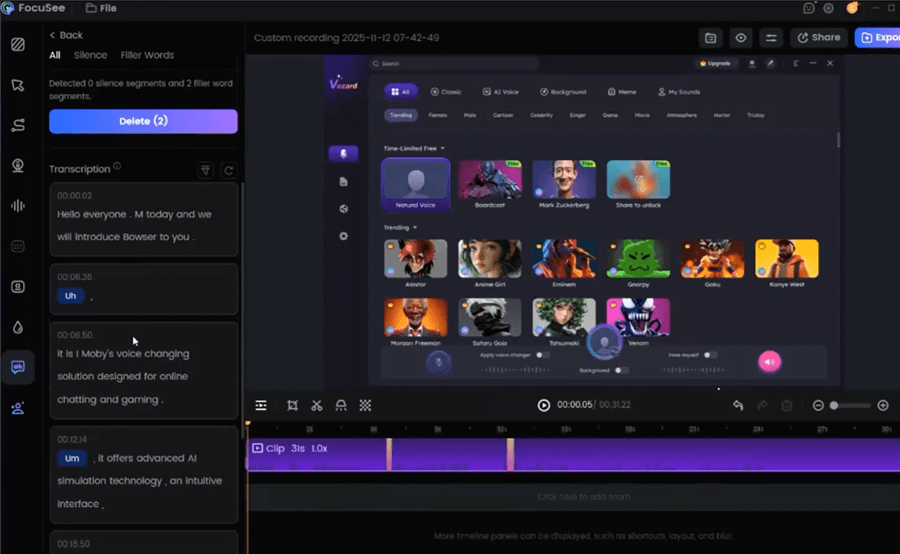
Remove Filler Words
Keep Mobile Viewers Engaged: To hold attention in a fast-scrolling feed, FocuSee offers Auto Zoom & Spotlight. Instead of tedious manual keyframing, the tool automatically follows cursor movements and highlights key on-screen actions. This ensures your vertical short-form videos remain visually dynamic and focused.
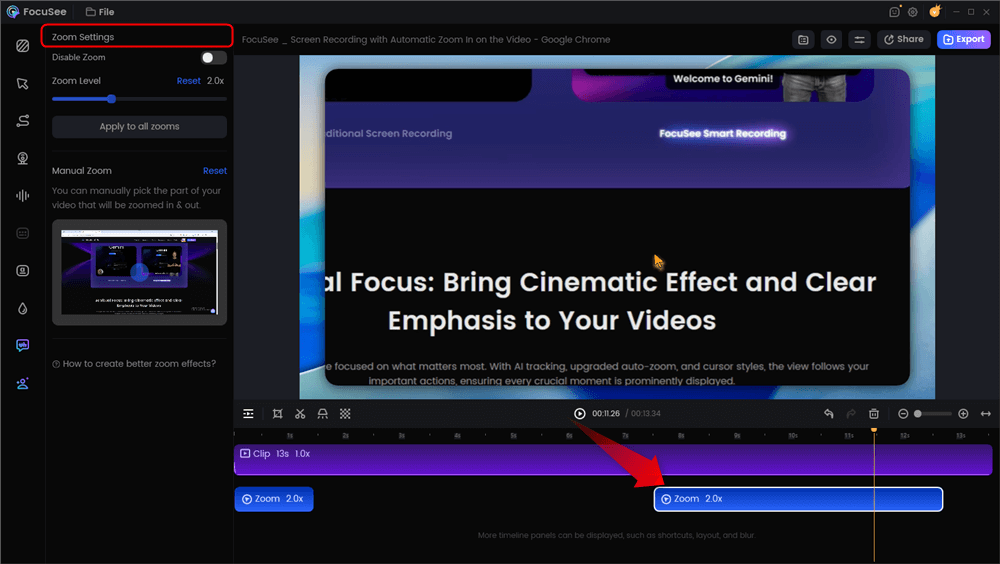
Automatic Zoom Effects
Ensure Professional Polish: To overcome technical barriers, FocuSee provides Auto Subtitles. It generates accurate captions in over 50 languages, making your content accessible and effective for silent autoplay environments.
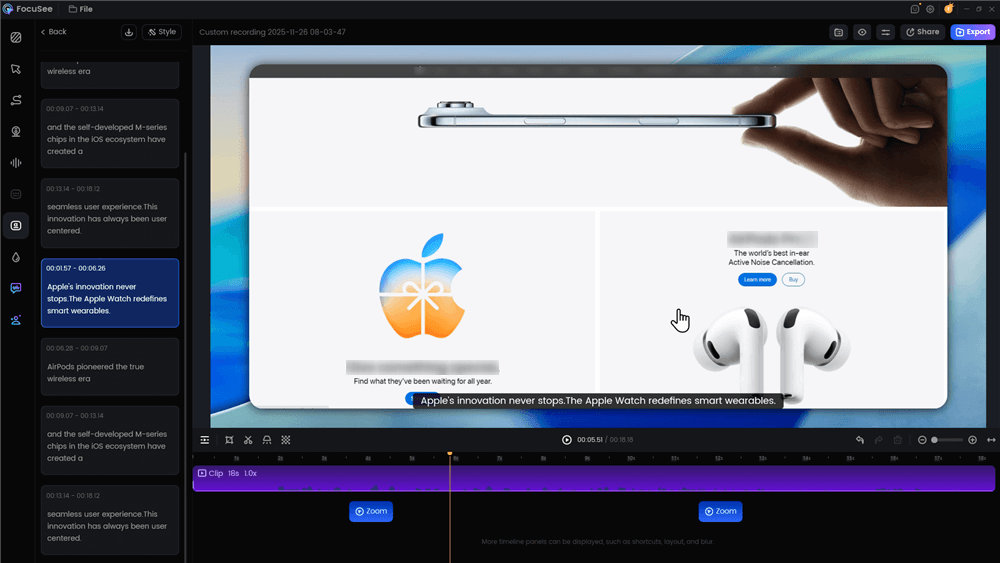
Automatic Subtitle Generation
By automating these time-consuming tasks, FocuSee empowers you to move from a single long-form video to a full suite of campaign assets in minutes, not hours.
Frequently Asked Questions About Marketing Video Length
What is the ideal length for a marketing video overall?
There is no single ideal length. The optimal duration is determined by your marketing goal and the platform. For broad awareness on social media, aim for 6–15 seconds. For consideration and traffic, 30–90 seconds is effective. For high-intent viewers on a landing page, 2–5 minutes can work well.
How long should an explainer or product demo be to convert on a landing page?
The explainer video length best practice for a landing page is between 90 seconds and 3 minutes. This provides enough time to detail the problem, present your solution, and show key features without overwhelming a visitor who is actively seeking information.
Where should I place my CTA in short vs. long videos?
In short videos (under 30 seconds), the CTA should appear in the final 2-3 seconds as an end card. For longer videos (over 90 seconds), include a mid-roll CTA (like on-screen text) around the 25-35 second mark, in addition to a final CTA, to capture viewers who may not watch to the end.
Conclusion
The endless debate about video length is a symptom of a larger problem: a lack of a clear, repeatable system. By shifting your focus from a single number to a strategic framework, you can create videos that are precisely tailored to your audience and goals. This data-driven approach removes guesswork, aligns your team, and delivers measurable results. Instead of struggling with inefficient workflows, you can implement this strategy with tools designed for speed and quality.
Take control of your video production process. See how FocuSee can help you automate tedious edits and create a full suite of perfectly-timed video assets in minutes. Solve the length problem for good.