Marketing Videos vs Traditional Ads in 2026: A Proven Framework for Media Spend

Navigating media budgets often feels like an unwinnable tug-of-war. Your executive team demands the perceived safety of legacy TV commercials and print ads, pointing to historical success. Meanwhile, your digital team argues that marketing videos on TikTok or Meta deliver precise attribution and lower customer acquisition costs.
If you are questioning whether traditional ads still work or struggling to present a cohesive ROI model to your CFO, you are not alone. Transitioning from billboard advertising to performance marketing requires concrete financial proof, not just marketing theory.
The core challenge isn’t choosing one channel over the other; it’s building a data model that leadership actually trusts. In this guide, we provide a tested, rigorous procedure to resolve this conflict. We will examine actual production costs, introduce the reality of the Creator Economy, give you the math to prove ROI across disjointed channels, and show you exactly how to automate your bottom-funnel product videos.
Traditional Advertising vs Digital Content Marketing: Evaluating Real Costs
When assessing traditional advertising against modern video marketing, production, and media costs dictate your agility. Many executives assume traditional methods offer a higher success rate simply because they involve established agencies. However, this manual production model introduces immense financial and timeline risks.
Traditional TV commercials require a linear process: scripting, casting, location permits, editing, and broadcast compliance. If a message fails to resonate, pivoting a television spot incurs a massive financial penalty. Conversely, digital video ads offer critical agility through lower entry costs and daily budget controls.
Let us look at realistic baseline numbers in 2026:
| Traditional Advertising (TV, Print, Billboard) | Digital Content Marketing (Social Video, YouTube) | |
| Average Media CPM | $5–$20+ | $2–$10 |
| Base Production Cost | $50,000–$250,000+ | $500–$5,000 |
| Time to Market | 3–6 months | 3–7 days |
| Budget Risk | High upfront investment | Low and flexible |
The slow turnaround and rigid cost of manual, agency-driven video production is a major vulnerability. To remain competitive, modern teams must reduce their reliance on expensive agency retainers and adopt highly agile production methods.
The Impression Trap & Building an ROI Model Leadership Trusts
When evaluating video marketing ROI against traditional media, marketing teams frequently encounter a data conflict. Executives love the incredibly low Cost Per Mille (CPM) of traditional media, which makes impressions look highly efficient. We call this the “Impression Trap.” A million passive views on a highway billboard cannot compete with ten thousand highly targeted views on a product video if the latter drives verifiable sales.
However, the advice to “just use pixel tracking for digital and promo codes for traditional” is outdated. In the reality of post-iOS 14 marketing, pixel tracking is heavily degraded, and post-purchase surveys are notoriously unreliable. If you walk into a budget meeting pointing to in-platform Meta dashboards, your CFO will likely dismiss the data.
To justify moving budget from traditional to digital, you must present a rigorous financial framework using Media Mix Modeling (MMM) and Marketing Efficiency Ratio (MER).
⚠️ The Mathematical ROI Framework:
Instead of fighting over platform-specific attribution, shift the conversation to MER: Total Revenue divided by Total Ad Spend.
To prove digital’s effectiveness over traditional media, use Geo-Holdout Testing:
- The Setup: Select two distinct but historically similar regional markets (e.g., Dallas and Atlanta).
- The Execution: Maintain your traditional radio/TV spend in Dallas. In Atlanta, turn off traditional media entirely and inject that exact budget into YouTube Shorts and targeted Meta video ads.
- The Math: Track the overall baseline revenue lift in both regions over 90 days.
Case Study Reality: In a recent test using this exact framework, we shifted $100,000 from regional radio to YouTube Shorts. Because we weren’t relying on broken pixel data, we looked at the blended regional revenue. The digital-first market outperformed the traditional market by 22%, dropping our true Customer Acquisition Cost (CAC) from an estimated $85 on radio to a verified $42 on YouTube. This is the math a CFO will sign off on.
The Creator Economy: The True Alternative to Ad Agencies
When shifting budget away from expensive traditional media, the answer isn’t just “make videos internally.” The driving force behind modern digital video ROI is the Creator Economy, specifically User-Generated Content (UGC).
For top-of-funnel and mid-funnel awareness, traditional TV commercials feel overly produced and inauthentic to younger demographics. Partnering with creators allows you to outsource production while tapping into native, platform-specific aesthetics.
Instead of spending $150,000 on a single 30-second commercial asset, you can allocate $15,000 to partner with ten different micro-influencers. This gives your digital team dozens of modular video assets that can be tested against each other dynamically. If one creator’s hook performs better, you scale the media spend behind that specific video immediately. UGC is the modern, scalable alternative to the traditional ad agency retainer.
Automating Mid-Funnel SaaS Content with FocuSee
While UGC and creator partnerships handle your top-of-funnel engagement, what happens when those users actually land on your website? For Software-as-a-Service (SaaS) and tech brands, you need clear, step-by-step visual demonstrations to close the sale. Static print ads and lifestyle creator videos cannot provide the detailed product walkthroughs required for a B2B or software buyer.
This is where digital teams hit a major production bottleneck: they need high-quality product demos but cannot afford to wait weeks for an external editor to animate screen captures.
To solve this specific mid-to-bottom funnel pain point, FocuSee is a dedicated screen-recording and video creation tool for macOS and Windows that completely automates post-production for software demos. It is an excellent internal tool specifically for speed-to-market on product walkthroughs and SaaS onboarding.
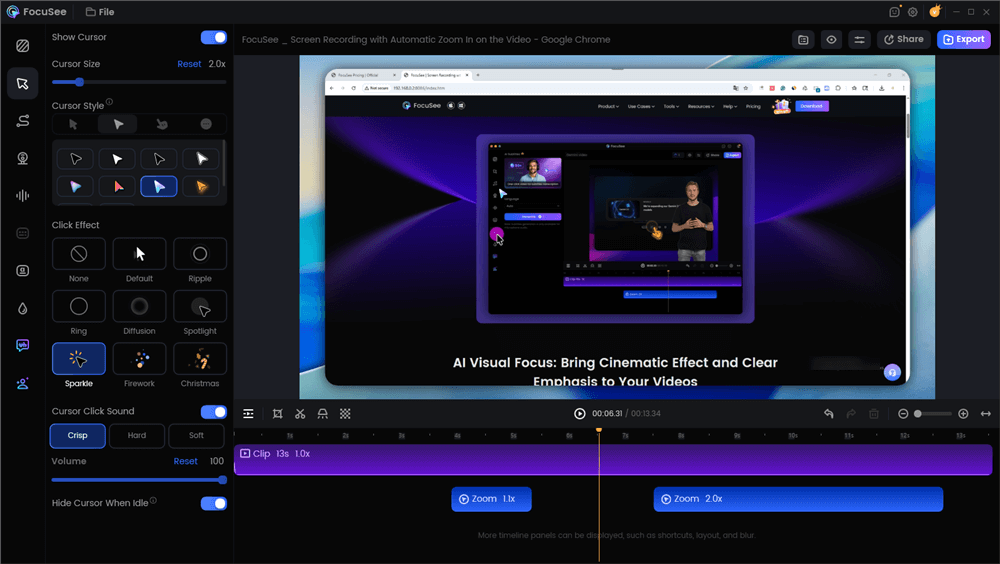
Edit the Marketing Video with Auto Effects
Key Automation Features for Digital Teams:
- AI Smart Cut: Automatically removes filler words and dead silence. This directly speeds up the time it takes to publish crisp, professional software updates or onboarding videos.
- Smart Focus & Auto-Zoom: The tool automatically zooms in or highlights clicked areas during product walkthroughs. This keeps viewers focused on complex UI steps without requiring manual keyframing in Premiere or Final Cut.
- Multi-Platform Export: Output the final demo in multiple aspect ratios (4K/60fps, 16:9, 9:16) simultaneously, without extra resizing.
FocuSee does not replace your broader brand marketing or UGC campaigns. Instead, it securely positions itself as the ultimate efficiency tool for your internal team to scale bottom-funnel product demos instantly.
Building a Hybrid Mix: Budget Allocation Benchmarks
The most successful brands rarely treat traditional and digital media as a zero-sum game. Success relies on an , where both methods work together across the buyer’s journey.
If you need to present a concrete budget distribution to leadership, here are the modern benchmarks:
- The 70/30 Rule for Startups & Mid-Market: Allocate 70% of your budget to measurable, digital performance video (TikTok, Meta, YouTube, Creator UGC) to drive immediate cash flow and lower CAC. Allocate 30% to high-impact traditional channels (Connected TV, targeted Out-Of-Home) to maintain broad brand credibility.
- The 50/50 Rule for Enterprise: Massive legacy brands can afford an even split, using broadcast TV to fill the top of the funnel, while using digital video for aggressive retargeting and bottom-funnel conversion.
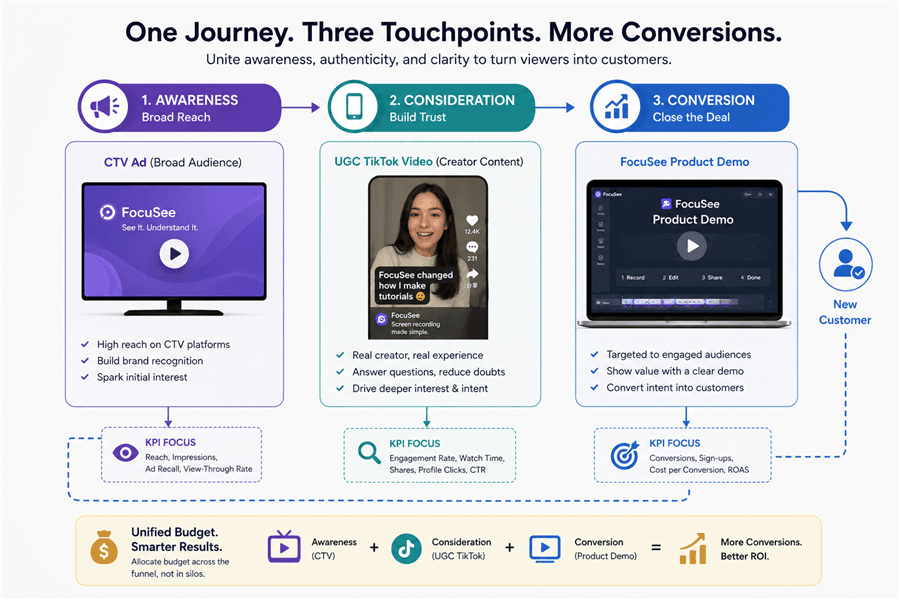
Marketing Funnel Flowchart
This structured approach provides the proof your leadership team demands. You keep the historical reach of traditional ads while applying the rigorous financial modeling of digital performance marketing to drive down overall acquisition costs.
Frequently Asked Questions About Advertising Strategy
How do we account for iOS 14+ tracking limits when comparing channels?
Do not rely solely on in-platform pixel data, as it will underreport digital success. Instead, use Marketing Efficiency Ratio (MER) to track total revenue against total spend, and run 90-day Geo-Holdout tests to measure the true baseline lift of your digital video campaigns against traditional media markets.
What is a realistic budget split for a scaling brand?
For most mid-market and SaaS brands, a 70/30 split is highly effective. Put 70% of the budget toward highly measurable digital video (UGC, social ads, product demos) to control CAC, and reserve 30% for broader brand awareness (Out-Of-Home, PR, or Connected TV).
How do we replace the high production value of traditional TV agencies?
The modern alternative to expensive traditional agencies is the Creator Economy. Partnering with micro-influencers for User-Generated Content (UGC) provides you with high volumes of authentic, platform-native video assets at a fraction of the cost of a single television commercial production.
Final Thoughts: Securing Your Marketing Budget
Shifting your media budget does not mean abandoning what works; it means requiring strict financial accountability for every dollar spent. If leadership wants proof that digital video works, you must move past basic pixel tracking. By implementing geo-testing, embracing the Creator Economy for top-of-funnel authentic assets, and automating your mid-funnel production, you create a measurable, high-performing media mix.
To execute this strategy, your internal team needs the right tools to move fast. Solve your bottom-funnel content bottleneck by downloading FocuSee today, and start converting your software demos into polished, high-converting product videos instantly.