SaaS Demo Examples: 6 High-Converting Demos That Drive Product-Led Growth

You have successfully driven traffic to your landing page, but the sign-ups aren’t following. For product marketers, this is a familiar frustration. You know your software solves a real problem, yet prospects bounce before understanding its value. The issue is rarely the product itself; it is how you present it.
Many professionals fall into the trap of offering a generic, comprehensive tour that overwhelms the user. However, effective 6 saas demo examples prove that brevity and relevance drive results. To ensure the insights in this guide are reliable, we analyzed strategies used by top-performing PLG (Product-Led Growth) companies to understand exactly how they structure their videos for maximum conversion.
The Breakdown: 6 SaaS Product Demo Examples by Funnel Stage
If you analyze the current market leaders, you will notice a distinct pattern: the best saas product demo examples map directly to the buyer journey. A CEO needs a different view than a developer, and a cold lead needs a different hook than a warm prospect.
We have moved past the era of the “one-size-fits-all” walkthrough. Below are 6 saas demo examples categorized by funnel stage. We will explore the strategy, describe what a “best-in-class” version looks like, and show you how to replicate it.
SaaS Product Demo Use Cases
1. The ‘Hook’ (Top-of-Funnel Video)
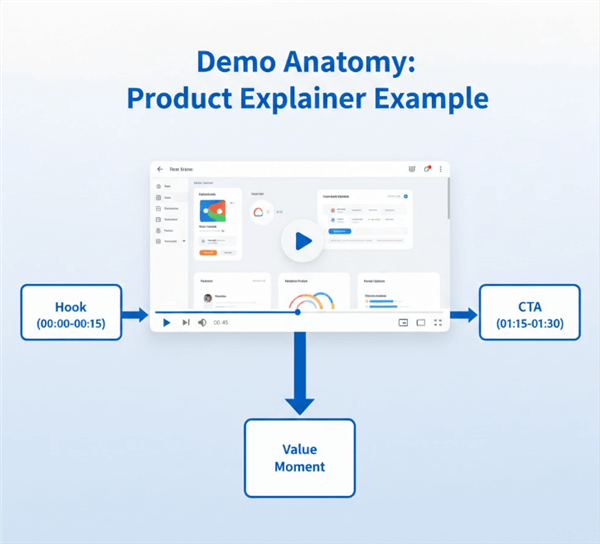
This acts as a 30-90 second teaser. Its primary goal is to generate interest, not to train the user. It addresses a high-level pain point immediately, often skipping the login screen or configuration steps to show the final result first.
- The Strategy: Think of how Loom or Slack market their products. They do not start by showing you how to set up an account. They start in media res—right in the middle of the action. You see a message being sent or a video being recorded instantly.
- What Good Looks Like: The video opens on the “Success Screen.” If you sell dashboard software, the first frame is a beautiful, fully populated chart. The narrator asks, “Tired of manual reporting?” and immediately clicks Export.
- Why it works: It respects the user’s time. It answers “What do I get?” before asking the user to do any work.
- Best for: Social media ads, landing page headers, and cold outreach.
2. The ‘Micro-Use Case’ (Feature Highlight)
Instead of a full platform tour, this demo isolates a single workflow—such as “Automating an Invoice” or “Exporting a Report.” It targets users searching for specific solutions rather than general software. By creating a library of these saas product demo use cases, you capture long-tail search traffic effectively.
- The Strategy: Companies like Zapier or Notion excel here. They don’t just have a “Product Tour” page; they have pages dedicated to “How to organize meeting notes” or “How to connect Gmail to Slack.”
- What Good Looks Like: A 45-second clip that starts with a specific problem (“I need to get this email data into a spreadsheet”) and ends the moment that task is complete. No fluff, no “Welcome to the platform” intro.
- Why it works: It solves a specific problem quickly. It proves to the user that your tool can handle their exact requirement.
- Best for: Help centers, feature pages, and answering specific sales objections.
3. The ‘Interactive Tour’ (Self-Serve)
Using interactive demo platforms, this method allows users to click through a guided simulation. It offers the feeling of ownership without the risk of a live sandbox environment. Self serve saas demo examples are critical for product-led growth because they let the product sell itself before a human ever gets involved.
- The Strategy: Look at Navattic or Arcade. They allow users to click buttons that trigger pre-recorded tooltips and screen transitions. It mimics the live software but keeps the user on “rails” so they cannot get lost or encounter bugs.
- What Good Looks Like: A “Try it Now” button on your homepage that opens an overlay. The user is prompted to “Create a Project.” When they click the button, the screen advances. It feels like they are working, but you are guiding the narrative.
- Why it works: It engages the user actively rather than passively. It reduces the “fear of the unknown” regarding your interface.
- Best for: Pricing pages and “Get Started” flows.
4. The ‘Persona-Based’ Walkthrough
This is a tailored video that speaks to a specific role (e.g., “For CFOs” vs. “For Developers”). It filters out irrelevant features, ensuring the viewer only sees what matters to their KPIs.
- The Strategy: HubSpot is the master of this. They have distinct product tours for “Marketing Hub,” “Sales Hub,” and “Service Hub.” A salesperson never sees the complex backend automation tools that a marketer needs.
- What Good Looks Like: The voiceover creates immediate rapport: “As a Finance Director, you care about cash flow, not code.” The screen recording then focuses strictly on audit logs, permissions, and financial reporting, deliberately ignoring the rest of the navigation bar.
- Why it works: It speaks the user’s language. It proves you understand their specific job, building trust.
- Best for: Email nurture campaigns and account-based marketing (ABM).
5. The ‘Mobile Experience’
Demonstrating mobile device recording (iOS/Android) is crucial for field-service or communication apps. It proves the product works seamlessly away from the desktop. Many b2b saas demo examples neglect this, leaving mobile-first buyers uncertain about usability.
- The Strategy: Linear or Monday.com often showcase their mobile apps to prove you can manage projects from anywhere.
- What Good Looks Like: A high-quality recording framed inside an iPhone bezel. The video shows a push notification coming in, a thumb tapping it, and a quick action being taken (like “Approve Request”). It emphasizes speed and touch responsiveness.
- Why it works: It provides proof of cross-platform capability. It reassures prospects that they won’t be tethered to their desks.
- Best for: Apps with a field workforce or heavy mobile usage.
6. The ‘Personalized Sales Follow-up’
This is a recorded recap sent after a meeting. It reinforces the sales enablement process by addressing specific questions raised during a call, using screen recordings to clarify complex answers.
- The Strategy: This is a technique used by high-performing account executives using tools like Vidyard. Instead of a long email recap, they send a 2-minute video.
- What Good Looks Like: The video starts with the salesperson on camera saying, “Hey [Name], great call today. I wanted to show you exactly how that integration we discussed works.” The screen then switches to the software to demonstrate that specific feature.
- Why it works: It provides a shareable asset the champion can show their boss. It keeps the deal momentum alive.
- Best for: Closing mid-market and enterprise deals.
Expert Insight: The most effective SaaS demo examples are outcome-driven rather than feature-driven. High-performing demos focus on helping users experience a specific success moment within minutes, instead of attempting to showcase the full product. This principle holds true across video, interactive, and automated demo formats.
Live Demos vs. Automated Video Walkthroughs
Choosing between a live presentation and automated saas demo examples is a strategic decision that impacts scalability and consistency. Live demos allow for relationship building, but they are resource-intensive and prone to technical errors. To scale your growth strategy, you must find the balance between high-touch sales and high-efficiency automation.
| Live Demos (Zoom/Teams) | Automated/Video Demos | |
| Scalability | Low (Limited by calendar slots) | High (Unlimited views) |
| Consistency | Variable (Depends on sales rep) | Perfect (Same message every time) |
| Risk Factor | High (Live bugs, internet issues) | Zero (Edited and polished) |
| Use Case | Bottom-of-funnel negotiation | Top-of-funnel awareness & education |
For complex B2B SaaS demo examples, a hybrid approach often works best: use automated videos to qualify leads and educate them on basics, then reserve live interactions for deep-dive technical questions. This ensures your sales team focuses only on high-intent prospects who have already experienced the product’s core value through demo automation.
How to Build Professional SaaS Demos Without a Video Team
You now know the strategies: The Hook, The Micro-Use Case, The Mobile Experience. But executing these strategies often hits a roadblock: production quality.
If you try to record a “Hook” video using basic screen capture software, it often looks amateurish. The cursor wanders, the screen is cluttered, and the viewer doesn’t know where to look. Historically, fixing this required hiring an editor to manually add zooms, pans, and cursor effects—a slow and expensive process.
This is where FocuSee becomes a practical asset for your marketing stack. It is designed specifically to replicate the high-end look of the examples we discussed above, but automatically.
Replicating the “Best-in-Class” Look with FocuSee:
- Auto Zoom: Remember how effective demos are when they zoom in on the action? FocuSee’s Smart Focus & Auto-Zoom automatically tracks your mouse clicks. If you click a “Settings” button, the video zooms in there seamlessly. This solves the pain point of explaining complex dashboards on small screens.
- The “Linear-Style” Polish: To avoid generic-looking recordings, FocuSee utilizes 3D Motionicon and customized backgrounds. It adds a cinematic tilt and smooth motion to cursor movements, instantly increasing the visual appeal without manual keyframing.
- The Mobile Frame: For the Mobile Experience strategy (Strategy #5), FocuSee allows you to wrap your recording in professional iOS or Android device frames with a single click. You don’t need After Effects to prove your app is mobile-ready.
By using tools that automate the editing process, you can produce a library of saas product demo use cases in an afternoon rather than a month.
Optimizing Your Demo: Metrics & The ‘Aha!’ Moment
Creating the asset is only the first step; optimization is where growth happens. To truly improve conversion optimization, you must measure more than just view counts. You need to identify the “Aha!” moment—the precise second in the video where the user grasps the product’s utility.
If you analyze your video retention graph and see a 40% drop-off at the 10-second mark, your intro is too long. You haven’t reached the value fast enough.
Key Optimization Metrics:
- Completion Rate: Do users watch until the Call to Action (CTA)?
- Time-to-Value: How quickly is the primary solution shown? If your “Aha!” moment is at 1:30, try editing it down to 0:45.
- Re-watch Ratio: Are users replaying complex sections? This often indicates confusion rather than interest.
Effective saas product demo use cases are iterative. Use these data points to refine your script and editing. If users drop off at a specific technical explanation, use a tool like FocuSee to simplify that segment with auto-zoom or a clearer voiceover
Conclusion
The uncertainty of how to present your product effectively can stall your marketing efforts. However, by adopting the strategies behind these 6 saas demo examples—from the high-level Hook to the Persona-Based walkthrough—you move from generic feature dumping to creating outcome-focused assets that convert.
You no longer need to rely on expensive agencies or complex editing software to achieve professional results. Tools like FocuSee allow you to regain control of your narrative. You can record, edit, and polish your demos in minutes, ensuring your prospects see your product’s true value immediately. Download FocuSee today to transform your raw screen recordings into high-converting assets and accelerate your product-led growth.
FAQs: Mastering Your SaaS Product Demo Strategy
To wrap up your sales enablement and growth strategy, here are answers to the most common questions about demo production.
What types of SaaS demos are most effective?
Outcome-driven demos are superior. Whether it is a self-serve saas demo example or a video walkthrough, the content must focus on solving a specific user problem (e.g., “How to save 5 hours a week”) rather than listing features (e.g., “Here is the settings menu”).
How long should a SaaS demo be?
For top-of-funnel awareness, aim for 60 to 90 seconds. For detailed product tours or on-demand demos, 3 to 5 minutes is standard. Anything longer should be broken down into specific chapters or a playlist of micro-use cases.
Can demo examples work for complex SaaS products?
Yes, but they require segmentation. Break the product down into specific workflows. Do not attempt to show the entire enterprise suite in one video. Use the “Persona-Based” strategy to show only what is relevant to the viewer.
How do I adapt demo examples to my own product?
Analyze your buyer journey. If you have a complex enterprise tool, start with a high-level “Hook” video to generate interest, then offer an interactive demo for those who want to explore. Use tools that allow for easy editing so you can A/B test different approaches without needing a full video production team.