The Complete Guide to Video Production and Marketing in 2026

For many marketing leaders, the video production process is a source of constant friction. A great idea stalls in endless script revisions, a finished video dies after a single social media post, and its business impact remains a mystery. This disconnected approach leads to wasted budgets and missed opportunities.
This guide provides the operational playbook to fix that. We’re moving beyond high-level strategy to give you the tactical tools—including downloadable templates and checklists—to connect every step, from initial brief to final revenue attribution. The methods here are based on hands-on execution. We will follow the journey of Alicia, a Director of Marketing who used this exact video production marketing strategy to launch a new product line, turning a one-off project into a scalable content engine.
What Is a Marketing Video
Phase 1: Video Production Marketing Pre-Production: Budget Planning and Creative Brief Essentials
Success is determined before the camera rolls. A meticulous pre-production phase prevents scope creep, budget overruns, and stakeholder misalignment.
The Cornerstone: The Pre-Production Brief
The pre-production brief is your project’s single source of truth, aligning your team on objectives, audience, messaging, and deliverables before resources are committed.
Your brief must include:
Strategic Foundation:
- Primary Goal: The specific business objective (e.g., “Generate 150 MQLs for Product X”)
- Target Audience: Define the persona and their primary pain point
- Core Message: The single most important takeaway
- KPIs: How you’ll measure success (VTR, CTR, Conversion Rate)
Creative Execution:
- Format & Tone: Video type and emotional feel
- Key Talking Points: 3-5 essential messages
- Call-to-Action: The specific next step for viewers
Operational Guardrails:
- Deliverables Matrix: Every asset needed (e.g., 90s 16:9 Hero, 30s 1:1 Social Ad, 15s 9:16 Story)
- Stakeholders & Sign-Offs: Approval workflow and review timeline
- Budget & Timeline: Top-line budget and key milestones
Making Budgets Actionable
Understanding video production costs for marketing is critical. Here’s what your budget actually buys:
- DIY/In-House (< $3,000): Basic gear upgrades (microphone, lighting), stock music, and software. Ideal for organic social and internal communications.
- Hybrid ($5,000–$20,000): Internal team with freelance specialists. A $15,000 budget breaks down as: DP (2 days, $2,400), Sound Recordist ($1,600), Equipment Rental ($2,000), Location Fee ($1,500), Talent ($2,000), Editor ($4,000), Contingency ($1,350).
- Agency ($25,000+): Full outsourcing for major campaigns requiring specialized expertise and high production value.
Phase 2: Scalable Video Production Strategy: How to Create Modular Marketing Content
An effective approach for maximizing ROI is the “modular content harvest.” This strategy treats a single shoot not as a project to create one video, but as an opportunity to generate an entire campaign’s worth of assets. This is the core of an effective video content marketing plan.
For her product launch, Alicia adopted this blueprint. Instead of scripting a linear 90-second video, she wrote distinct modules. Her script looked something like this:
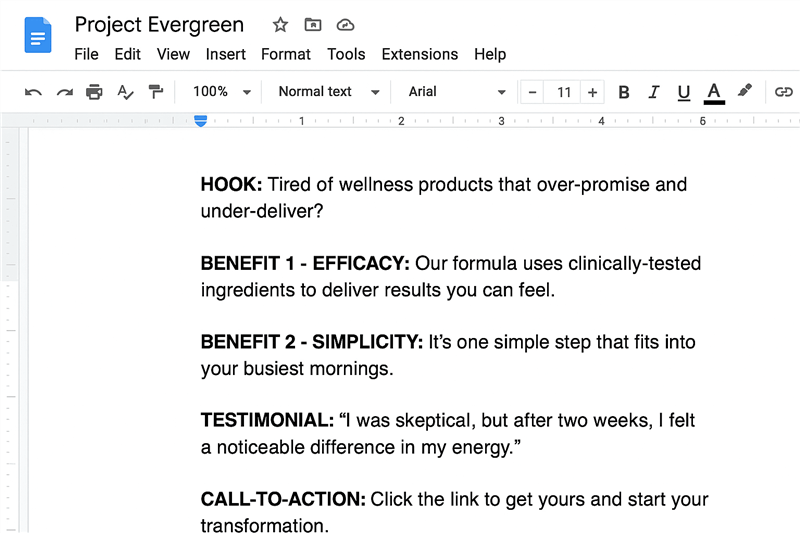
Script for a Marketing Video
By slating each take with a module tag (e.g., “Hook 1, Take 3”), her team saved hours in post-production. Planning a deliverables matrix upfront ensured they captured the necessary A-roll and B-roll with correct framing for vertical and square formats. This transformed one shoot day into a complete set of modular content and cutdowns for omni-channel distribution:
A 90-second hero video for the website and YouTube.
Multiple 30-second social ads (e.g., Hook + Benefit 1 + CTA).
15-second vertical clips for Instagram Stories (e.g., Testimonial + CTA).
A 6-second bumper ad for YouTube pre-roll.
From the Field: Pro Tips for Production Day
Audio is Everything: A lavalier mic is crucial because clean audio is more important than 4K video for audience retention. Place it on the chest, about a hand width from the chin, to avoid a muffled sound. Always record dual audio (e.g., lav mic and a boom mic) if possible.
The Gear That Matters: Our methodology note mentions a Sony a7S III. A key benefit of a camera like this is its dual card slots. Recording to two cards simultaneously is cheap insurance against a corrupted file, which can save an entire shoot day from being a total loss.
Embrace the Slate: It feels old-fashioned, but a simple slate (or even a tablet app) with the module and take number creates a visual marker that makes finding the best takes in post-production dramatically faster.
Phase 3: Video Production and Marketing Workflow: Post-Production Best Practices
Streamlined post-production and solid asset management transform raw footage into a polished campaign without chaos.
Choosing Your Model: In-House vs. Agency Video Production
- Cost & ROI: In-house teams require upfront investment but offer lower per-video costs long-term. Agencies have higher per-project costs but eliminate overhead.
- Speed & Agility: In-house teams move faster on product-specific projects. Agencies provide structured workflows for complex productions.
- Specialized Expertise: Agencies offer immediate access to specialists in motion graphics and advanced editing. Building in-house expertise takes time.
- Scalability: In-house teams have fixed capacity. Agencies scale production to match your content calendar.
Phase 4: Distribution and Measurement
A video’s value is realized through strategic distribution across search, organic, and paid channels.
Multi-Channel Distribution Plan
- Search Optimization: Maximize long-term discoverability with keyword-rich titles, detailed descriptions, and chapter markers on YouTube. Implement VideoObject schema markup on your website to enhance search visibility.
- Organic Reach: Deploy a content repurposing framework—post the full video on YouTube, a 60-second square cutdown on LinkedIn, and a 30-second vertical clip on Instagram Reels, each with platform-specific hooks.
- Paid Amplification: Allocate 5-10% of production budget for initial ad spend. This generates early performance data to optimize your creative.
“The biggest mistake is treating launch day as the finish line. Use a two-week optimization loop. If your three-second hold rate is below 65% on TikTok, test a new hook immediately. If your YouTube VTR dips at the 20-second mark, you know exactly which message isn’t landing. Data-driven iteration is what separates good video content from great video marketing.”
— Maria Chen, Video Strategist (Allbirds, Glossier)
Performance Measurement
Align KPIs with your funnel stage: track view-through rate (VTR) for Top-of-Funnel awareness, click-through rate (CTR) for Middle-of-Funnel consideration, and conversions for Bottom-of-Funnel decisions. Implement consistent UTM tracking for attribution.
Automate Your Video Production Marketing Workflow with AI-Powered Tools
Once you’ve mastered the manual workflow and understand the fundamentals of strong briefs and modular structure, intelligent automation can scale your process exponentially. For teams balancing limited resources with high-volume demands, FocuSee accelerates your marketing video production by eliminating common bottlenecks.
FocuSee implements the best-practice workflow covered in this guide:
- Close Post-Production Skill Gaps: AI Edit automatically removes filler words, pauses, and mistakes—transforming raw recordings into polished content without manual editing expertise.
- Generate Multi-Format Assets Instantly: Auto-resize creates 16:9, 1:1, and 9:16 cutdowns from a single master video, implementing the modular content strategy without repetitive reformatting work.
- Add Professional Captions Automatically: Auto-generate accurate, platform-optimized subtitles that improve accessibility and boost engagement rates across all channels.
The result? Transform a traditionally week-long post-production process into hours, allowing your team to focus on strategy and performance optimization rather than repetitive technical tasks.
Conclusion
The frustration of a fragmented video production and marketing process is a real obstacle. By adopting the unified, modular strategy outlined here, you can move from chaotic tasks to a predictable system. This operational playbook gives you the control to ensure every video you produce is a strategic investment.
Ready to build a video workflow that works? Start by downloading the brief template, and when you’re ready to scale, generate your first marketing video with FocuSee.
Video Production and Marketing FAQs
How do I plan a video that aligns with marketing goals?
Start with our pre-production brief template. It forces you to define the target audience and the specific action you want them to take, mapping the video’s message to a stage in the buyer’s journey: TOFU, MOFU, BOFU.
What is a realistic budget and timeline?
A small in-house team can often produce social videos for under $3,000 in 1-2 weeks. Hiring freelancers for a polished hybrid production can cost $15,000 and take 4-6 weeks. Full end-to-end video production and marketing services from an agency typically start at $25,000 and take 6-8 weeks.
How do I script for multiple video cutdowns?
Write your script in self-contained modules (e.g., hook, benefit 1, proof, CTA), as shown in our modular harvest section. This allows you to easily reassemble them into different lengths, which is key for repurposing video content for social.
What gear and software provide the best ROI on a budget?
Invest first in a quality lavalier microphone and a set of portable LED lights—good audio and lighting are more impactful than a fancy camera. For software, a subscription to Adobe Creative Cloud or an intelligent platform provides an excellent return.
What deliverables should I export for different platforms?
Export a 16:9 for YouTube/website, a 1:1 for LinkedIn/Instagram feeds, and a 9:16 vertical for TikTok/Reels. Always include a version with burned-in accessibility captions.
How do I track video marketing success?
For TOFU (awareness), track view count and retention. For MOFU (consideration), track CTR. For BOFU (decision), track conversion rate and attribute revenue using UTM parameters in a campaign measurement dashboard.