TikTok vs YouTube Shorts: Maximizing ROI in 2026

You pour hours into recording, hit publish, and wait. Sometimes, your TikTok content performs incredibly well—driving a sudden, massive spike in sales one day—and then absolute silence the next. Meanwhile, your YouTube Shorts generate slower, steadier growth but deliver more evergreen traffic.
If this sounds familiar, you are likely in the same position as Mia, a growth lead for a fast-growing e-commerce skincare brand I recently worked with. With paid acquisition costs rising across the board, Mia needed a platform strategy that balanced viral reach, consistent conversions, and efficient content production. Her team was overloaded trying to create platform-specific content from scratch, and the burnout was real.
Instead of guessing whether you should allocate your budget exclusively to one platform, you need a streamlined method that leverages the strengths of both. This guide provides a tested, data-backed solution to balance viral discovery with compounding traffic, helping you regain control over your content pipeline without exhausting your team.
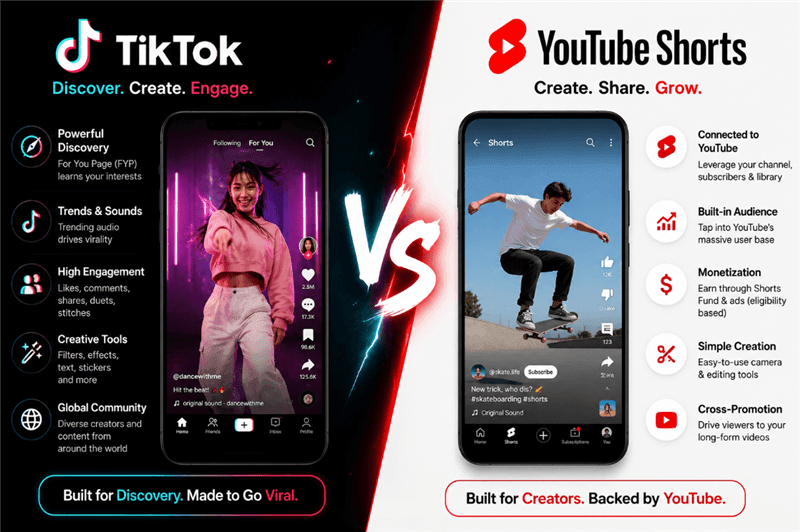
TikTok vs YouTube Shorts
Also Read: The 2026 Expert Guide to Short Product Demo Videos for TikTok >
The Production Bottleneck: Manual Editing vs Professional Workflows
Before diving into a strategic comparison of TikTok and YouTube Shorts, we have to address a critical operational hurdle: how you produce your short-form assets. The underlying issue for most overloaded teams isn’t a lack of ideas; it’s a lack of bandwidth.
Relying on manual editing methods—such as clipping footage natively in YouTube Studio or building complex videos directly inside the TikTok app—introduces massive hidden costs.
A frequent mistake marketers make to save time is blind cross-posting: exporting a watermarked video directly from TikTok and uploading it to YouTube Shorts with the exact same metadata. This universally fails. The algorithms prioritize entirely different viewer behaviors. If you don’t adjust your pacing, hooks, and metadata, your reach will be severely penalized.
To solve this, you must compare traditional manual editing against centralized, professional workflows:
| Native App Manual Editing | Centralized Professional Workflows | |
| Success Rate | Platform-specific; weaker for cross-posting | Consistent quality across channels |
| Time Cost | Hours of manual editing & exporting | Faster production with automation |
| Technical Skill | Requires mobile editing expertise | Lower skill barrier |
| Safety Risk | Risk of lost drafts & inconsistent branding | Centralized assets & brand consistency |
Moving away from native-app editing is the first step toward improving your creator economy presence. You need a reliable video creation tool to make multi-platform posting viable. But the type of tool you need depends entirely on what you are selling.
Strategy Split: DTC Lifestyle Brands vs B2B SaaS Companies
One of the most frustrating pieces of generic marketing advice is treating a direct-to-consumer (DTC) beauty brand and a B2B software company as if they require the same content strategy. They do not.
For DTC and E-commerce Brands
If you are scaling a lifestyle, beauty, or consumer goods brand like Mia’s skincare line, your content relies heavily on authentic, fast-paced User-Generated Content (UGC). Your production team should be shooting high-quality core footage on an iPhone 16 Pro or DSLR, and then using agile editors like CapCut or Premiere Pro to add platform-specific trending audio, fast jump-cuts, and native-looking text overlays.
For B2B and SaaS Brands: Scaling with FocuSee
If you are a B2B or SaaS marketer, replicating chaotic DTC dance trends or aggressive influencer hooks will ruin your credibility. Your audience wants clear, authoritative solutions to their software problems.

Show Mouse Cursor
For SaaS teams dealing with production bottlenecks, FocuSee—a powerful screen-recording and video creation tool for macOS and Windows—is an absolute game-changer. It is specifically designed to automate the creation of software demos and tutorials.
- Smart Focus & Auto-Zoom: When creating a SaaS walkthrough, FocuSee automatically zooms in and highlights your cursor actions. This keeps viewer focus high on small UI elements without requiring your team to manually set complex keyframes.
- AI Smart Cut: It instantly trims out filler words (“uh,” “um”) and long pauses, resulting in a concise, authoritative tutorial.
- Multi-Platform Export: You can record one high-quality software demo and export it in 9:16 for Shorts and 16:9 for YouTube seamlessly.
If you are selling software, pitch the native apps and adopt a tool like FocuSee to build your educational content library in half the time.
Platform Intent: Active Interest vs Compounding Search
Here is a crucial expert insight that most generic guides miss: Brands often compare TikTok and YouTube Shorts as if they serve identical functions, but user intent differs significantly.
TikTok tends to outperform for trend-driven discovery and impulse purchasing. It acts as an active interest graph, pushing high-engagement content to untested audiences rapidly. If an ecommerce skincare product spikes here, it’s because the visual hook triggered an immediate emotional response.
YouTube Shorts, however, benefits from stronger long-tail algorithm discovery because it connects directly with Google and YouTube’s broader search ecosystem. Viewers here are often looking to answer a question or solve a problem.
Brands that treat TikTok as an aggressive testing ground and YouTube Shorts as a compounding content library see stronger long-term ROI. You do not need to choose the “best platform”—you need to use them in sequence.
💡 PRO-TIP: The Creator Partnership Split
When hiring influencers, give them different briefs based on the platform. For TikTok, ask creators for raw, entertaining, reaction-based content that drives impulse clicks. For YouTube Shorts, ask creators for mini-reviews, “how-to” tutorials, and deeper product breakdowns that will capture search traffic over time.
A Concrete Procedure for Repurposing One Master Video
How do you optimize one core video for both platforms without contradictory editing styles? You separate the Core A-Roll from the Platform Packaging.
You do not just click export and post the exact same file. Here is how you actually do it:
- Shoot the Core A-Roll: Record your high-quality, base video. Keep the pacing relatively brisk, but don’t add any text or music yet.
- Test on TikTok (The Impulse Edit): Take that core footage and edit it for TikTok. Add a trending audio track, use native TikTok text overlays that pop up in the first 3 seconds, and write a conversational caption. Monitor the immediate engagement.
- Optimize for YouTube Shorts (The Search Edit): Take the same core footage, but strip away the chaotic trending audio. Add a clean voiceover or subtle background track. Most importantly, entirely rewrite the metadata to capture Google Search intent.
Real-World Metadata Example: Hydrating Serum
Here is exactly how Mia repurposed a winning video about her brand’s hydrating serum:
| TikTok (Trend & Impulse Focus) | YouTube Shorts (Search & SEO Focus) | |
| On-Screen Text (Hook) | “Wait… why is my skin literally glowing right now? 😭✨” | “How to Fix Dry Winter Skin in 3 Steps” |
| Title / Caption | “The girls that get it, get it. Link in bio! #skintok #glowyskin #grwm” | “Best Hydrating Serum for Dry, Flaky Skin” |
| Description | Not commonly used; relies on captions and hashtags | Keyword-rich description explaining benefits and context |
| Tags / Hashtags | #skintok #beautytok #viralmakeup | dry skin routine, best hydrating serum, hyaluronic acid benefits, winter skincare |
By changing the packaging (metadata, text, and audio) while keeping the product footage identical, Mia successfully engaged TikTok’s impulse buyers and YouTube’s search-driven audience without shooting two separate campaigns.
Paid Performance and ROI: Real Numbers and Benchmarks
When organic reach plateaus, deciding where to allocate your ad budget becomes critical. Evaluating paid performance requires looking at real data, not theory.
When I was scaling my first DTC brand a few years ago, I made the mistake of dumping our entire budget into TikTok ads because they were “cheap.” What I learned the hard way—and what I now advise clients—is that while TikTok offers a low Cost Per Mille (CPM), the Customer Acquisition Cost (CAC) can fluctuate wildly week-to-week.
Here is a realistic benchmark comparison based on recent cross-industry averages:
TikTok Advertising:
- Average CPM: $2.00 – $5.00
- The Reality: TikTok is an incredible engine for top-of-funnel brand awareness. Because user intent leans heavily toward rapid entertainment, viewers are easily distracted. Your ads must blend seamlessly with organic UGC content. While clicks are cheap, your CAC can be unstable because these are impulse buyers, not necessarily high-intent shoppers.
YouTube Shorts Marketing:
- Average CPM: $5.00 – $10.00
- The Reality: YouTube Shorts generally presents higher CPMs but yields a much more stable CAC—often stabilizing at 15-20% lower than TikTok over 6 months. Because Shorts are integrated into Google’s ecosystem, audience targeting relies heavily on search history (e.g., targeting users who literally just googled “best hydrating serum”). This deeper behavioral data supports consistent conversions from high-intent buyers.
The Winning Strategy: Use TikTok ads to acquire affordable, top-of-funnel traffic and build brand awareness. Then, apply YouTube Shorts campaigns to retarget those users and capture the high-intent buyers searching for solutions.
Frequently Asked Questions
Which platform has better organic reach?
TikTok typically offers faster, explosive initial reach for new accounts due to its active interest algorithm. However, YouTube Shorts provides longer-lasting organic reach; a well-optimized Short can surface in Google search results months or even years after publishing.
Which platform converts better for e-commerce?
TikTok drives high-volume impulse purchases, particularly for beauty, fashion, and low-ticket items. YouTube Shorts often delivers more consistent, high-converting traffic for considered purchases ($50+) because the audience targeting is backed by Google search intent.
How often should brands post?
Consistency matters more than raw volume. Aim for 3 to 5 high-quality, platform-optimized videos per week on both channels rather than dumping 10 poorly edited clips into the void.
Do I really have to edit differently for each platform?
Yes. As shown in the metadata breakdown, the core footage can remain the same, but you must tailor the on-screen text, audio, and captions. TikTok requires fast, native-looking UGC edits. YouTube Shorts audiences tolerate slightly more polished, structurally traditional content.
Reclaim Your Video Workflow and ROI
You no longer need to guess where to allocate your budget. By aligning your strategy with user intent—testing on TikTok for rapid discovery and building a compounding, search-friendly library on YouTube Shorts—you capture both impulse buyers and long-term traffic.
Executing this requires stepping away from blind cross-posting and clunky native apps. If you are an ecommerce brand, streamline your core video shoots and focus on platform-specific metadata. If you are a B2B SaaS company struggling to create software tutorials, a professional tool like FocuSee solves your production bottleneck in minutes by automating the most tedious editing tasks.
Note for long-term planning: Professional automated tools like FocuSee regularly update their export presets to align with the latest algorithm changes from both TikTok and YouTube Shorts. This ensures your content remains technically optimized without ongoing manual effort from your team.
Regain control of your workflow, protect your budget from unpredictable ad costs, and scale your short-form content efficiently. Use the data, tailor your hooks, and start turning those views into compounding revenue today.