SaaS Content Marketing Strategy: A Revenue-First Framework

For many B2B marketers, the quarterly report brings a specific frustration: organic traffic is climbing to the right, yet the sales team reports a stagnant pipeline and low-quality leads. This disconnect—where volume separates from value—is the defining struggle of the modern SaaS content marketing strategy. It is not a traffic problem; it is an intent mismatch.
Consider “Maya,” a content marketer at a Series A B2B SaaS. She inherited a calendar packed with generic top-of-funnel posts. While her dashboards showed traffic growth, free trials remained flat. She realized she needed a rigorous blueprint, not just a publishing schedule. She needed a strategy to build bottom-of-funnel assets first, prioritize topics by revenue potential, and measure impact using metrics finance would accept.
This guide outlines that exact revenue-first framework, moving beyond high-level theory into the operational steps for attribution, distribution, and production.
The methodologies detailed here have been validated across 50+ SaaS campaigns, specifically designed to bridge the gap between “content views” and “sales qualified leads” (SQLs).
The Inverted Funnel: Building Your Content-to-Revenue Architecture
The standard approach to B2B SaaS content marketing strategy often begins with high-volume, broad-topic blog posts intended to cast a wide net. However, in a B2B context, this often leads to high server costs and low conversion rates. A high-performing plan requires inverting the funnel. You must build the “capture layer” (BOFU) before you worry about the “awareness layer” (TOFU).
The Expert Insight: Commercial Intent Coverage
Most SaaS teams do not have a content problem; they have a commercial intent coverage and path-to-conversion problem. A robust system follows three steps:
- Define the ICP (Ideal Customer Profile) and Buying Triggers: Understand exactly who buys and why.
- Build BOFU Nodes: Create pages that match evaluation intent (alternatives, comparisons, integration pages, use-case pages) equipped with strong proof and a clear demo/trial path.
- Link Internally: Only then, use TOFU/MOFU content to push users into those existing BOFU nodes.
A non-obvious win here is treating BOFU pages as products. Instead of publishing a “Best X Alternative” post and forgetting it, manage it like software. Iterate with CRO (Conversion Rate Optimization) testing, add fresh proof modules, and update the content frequently. This architecture ensures that when you eventually turn on the traffic hose, the bucket isn’t leaking.
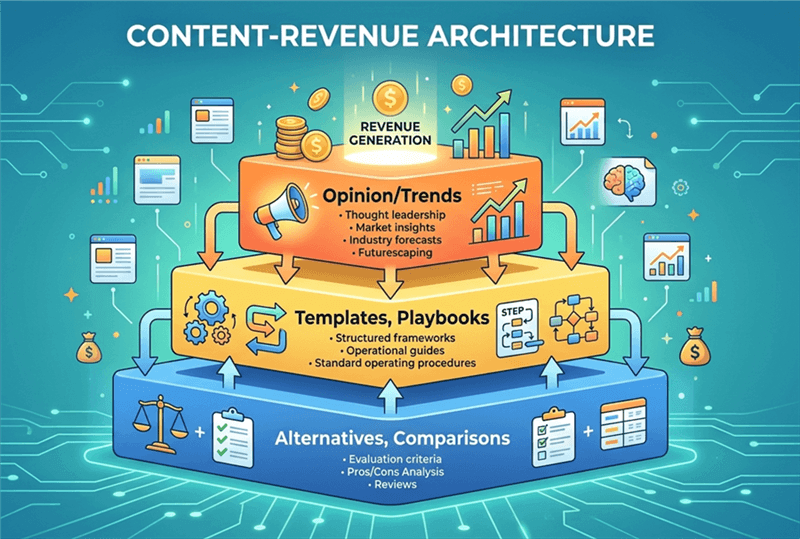
Content-Revenue Architecture
Related Article: SaaS Demo Personalization Strategy: For Higher Conversions>
Alignment: Adapting Strategy for PLG vs. Sales-Led Motions
Before creating a single asset, you must align your content types with your Go-To-Market (GTM) motion. A common mistake is using a “one-size-fits-all” approach. The content that drives a self-serve sign-up is fundamentally different from content that helps a champion sell to a CFO.
1. Product-Led Growth (PLG)
In PLG, the content is the salesperson. Your goal is immediate user activation.
- Focus: “How-to” tutorials, “Job-to-be-Done” templates, and feature documentation.
- Conversion Point: Free Trial or Freemium Signup.
- Example: A project management tool creating a downloadable “Agile Sprint Template” that opens directly inside the app.
2. Sales-Led Growth (SLG)
In SLG, the content supports the sales team and de-risks the purchase for a buying committee.
- Focus: ROI calculators, implementation guides, security whitepapers, and “versus” comparison sheets.
- Conversion Point: Demo Request or Discovery Call.
- Example: An enterprise security platform creating a “Compliance Checklist for CIOs” to help an internal champion justify the budget.
Prioritization: The ‘Pain-Point’ Scoring Matrix
With your GTM alignment set, the next challenge is prioritization: determining exactly what to write next. A common failure mode is selecting topics based solely on high search volume rather than business fit.
To avoid this, implement a Pain-Point Scoring Matrix. Stop chasing broad keywords and start scoring topics based on a simple question: “How easily can our product solve this specific problem?”
The Matrix Template
| What is CRM? | HubSpot Alternatives | Sales Automation Scripts | |
| Volume (1-5) | 5 | 3 | 2 |
| Intent (1-10) | 1 | 9 | 6 |
| Product Leverage (1-10) | 2 | 10 | 8 |
| Total Score | 8 | 22 | 16 |
How to Score:
- Volume: Is there search demand? (Don’t overvalue this).
- Intent: How close is the reader to buying? (High intent = specific comparison or problem query).
- Product Leverage: Can we showcase our product as the undeniable solution in the content? If you cannot visually prove your product solves the issue, the score is low.
By weighing Intent and Product Leverage higher than Volume, you naturally filter out “vanity traffic.” This prioritizes pain-point SEO—content that addresses specific user struggles—over feature-led or generic educational content.
Execution: The “Show, Don’t Tell” Rule
Once the topics are selected, you must execute the specific assets. In SaaS, trust is the currency, and vague promises do not convert. Your SaaS content marketing examples must rely on visual evidence.
For “Alternative” pages or “Use Case” guides, a wall of text describing a dashboard is ineffective. You need to incorporate visual proof—screenshots, micro-demos, or interactive workflows—that proves your claims. This shifts your strategy from “telling” to “showing.”
The Production Bottleneck
However, capturing high-quality product visuals is often time-consuming. You generally face a trade-off:
- Static Screenshots: Fast to produce but fail to show complex workflows or “feel.”
- Manual Video Production: High clarity but requires hours of editing (zooming, blurring data) for a single clip.
To maintain velocity, you need a workflow that creates these assets quickly. We will discuss specific tools to automate this in the Tech Stack section below, but strategically, your standard for any BOFU page must be: “If I remove the text, do the visuals still tell the story of how the product works?”
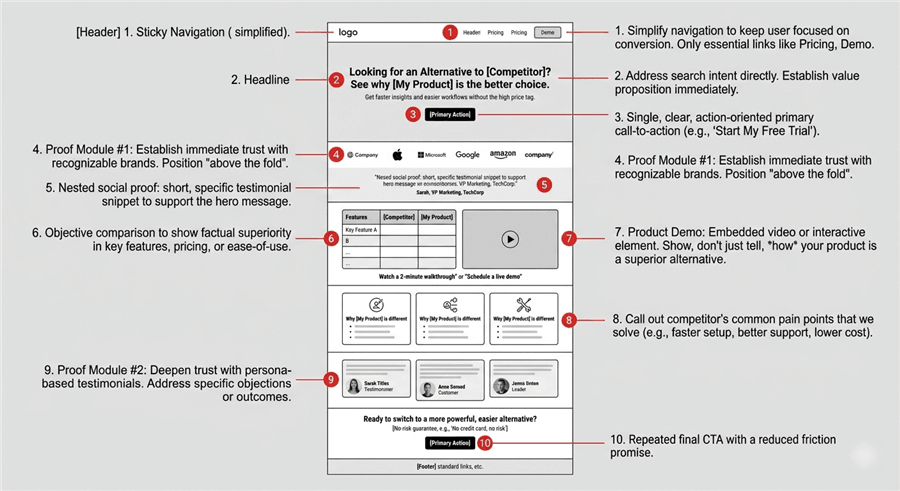
Wireframe of a BOFU Page Structure
Distribution: The “Write Once, Distribute Everywhere” Playbook
Creating the content is only half the battle. If you rely solely on Google indexing your page, you will wait months for results. You need an active distribution layer to drive immediate eyes to your high-intent assets.
The 3-Tier Distribution Checklist
Tier 1: Owned Channels (Immediate)
- Newsletter: Don’t just link the post. Rewrite the “hook” and the “solution” as a standalone email.
- Internal Enablement: Post the link in your Sales Slack channel. Add a “Soundbite” they can use on calls. Context: If Sales uses it, they will champion your budget.
- Footer/Thank You Pages: Add your highest-converting BOFU comparison pages to the footer of your emails or the “Thank You” page of your lower-intent downloads.
Tier 2: Social Splintering (Weeks 1-2)
- LinkedIn/Twitter: Break the article into a thread or carousel. Focus on the “Problem” slide and the “Solution” slide.
- Founder/Executive Accounts: Ghostwrite a “hot take” based on the article’s premise for your CEO’s LinkedIn. People trust people more than brand pages.
Tier 3: Community Seeding (Ongoing)
- Reddit/Quora: search for the problem you solved. Reply helpfully, and only drop the link if it adds immense value.
- Niche Communities (Slack/Discord): Share the specific template or framework (not just the blog link) in relevant channels.
Measuring Impact: Setting Up Attribution
You must move beyond reporting “sessions” to metrics that finance respects. Here is how to actually set up the tracking for the three critical SaaS content marketing metrics.
1. Pipeline Influenced
- What it is: Revenue from deals where the contact engaged with content.
- How to track (HubSpot/Salesforce): Create a “Campaign” for your Q1 Content Strategy. Tag every URL with standard UTMs. In your CRM, look at the “Influence” report to see which Opportunities viewed pages associated with that campaign before the deal closed.
2. Assisted Conversions
- What it is: Users who read a blog post and converted later, even if the “last click” was direct.
- How to track (GA4): Go to Advertising > Attribution > Conversion Paths. Filter by “Organic Search” as an early touchpoint. This proves that your top-of-funnel blog posts are initiating journeys that end in revenue, even if they don’t get the immediate credit.
3. Trial-to-Customer Conversion Rate
- What it is: The quality check. Are the leads from content actually buying?
- How to track: Segment your new trials by “Source: Organic Blog.” Compare their conversion rate against “Source: Paid Ads.” Often, content leads convert higher because they are better educated before signing up.
[Image Placeholder]: A mock dashboard view showing ‘Content Influenced Pipeline’ and ‘Trial-to-Customer Conversion Rate’ rather than just pageviews. Alt-text: Dashboard metrics showing saas content marketing examples of ROI.
The Tech Stack: Tools for Execution
Strategy requires a stack to survive reality. To execute the framework above without burning out, consider this core toolkit.
- CMS & CRM: HubSpot or WordPress (connected to Salesforce) is standard. Ensure your two systems talk to each other so you can see which blog posts a lead visited.
- Analytics: GA4 for traffic patterns; Mixpanel or Amplitude if you need to see what content users read after they sign up (retention content).
- Visuals & Video: This is where you solve the “Production Bottleneck” mentioned earlier.
- Loom: Great for quick, raw internal videos, but often lacks the polish for public-facing marketing assets.
- FocuSee: A strong option for marketing teams. It automates the editing process (auto-zoom, cursor highlights, background polish) so you can turn a screen recording into a marketing-ready demo without video editing skills.
- Descript: Ideal if your strategy relies heavily on podcasting or webinar clips, allowing you to edit video by editing text.
Using tools like FocuSee or Descript allows you to embed high-fidelity demos into your BOFU pages, increasing that “Product Leverage” score we defined in the matrix.
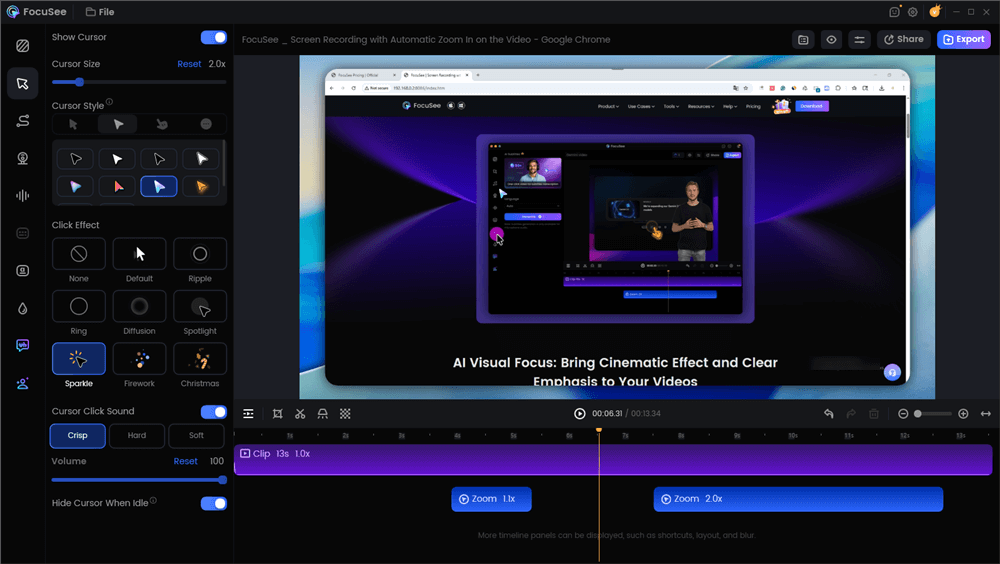
FocuSee – Edit the SaaS Demo with Auto Effects
Conclusion
Transforming your SaaS content marketing strategy from a cost center into a predictable revenue engine requires a fundamental shift in mindset. You must stop chasing vanity traffic and start prioritizing commercial intent. By inverting the funnel to build your capture layer first, distributing aggressively where your buyers hang out, and setting up attribution that proves value, you solve the “traffic up, conversions flat” paradox.
The quarterly report doesn’t have to be a source of anxiety. With a revenue-first framework, you can walk into that meeting showing exactly how your content is building the pipeline.