Top Alternatives to Live Demos for SaaS Marketing (2026)

For many revenue leaders, the reliance on manual walkthroughs has become a bottleneck. If you are researching alternatives to live demos for SaaS marketing, you likely face the same operational ceiling Laura did. Laura, the head of marketing at a mid-market SaaS company, noticed a disturbing trend: her Account Executives were booked solid, yet revenue remained stagnant. They were spending hours giving basic “harbor tours” to low-intent prospects who simply wanted to see the interface, leaving little energy for the complex, high-value deals.
She realized that to scale, she needed reliable SaaS demo alternatives that could educate buyers without burning out her team. But the challenge wasn’t just about making a video; it was about integration. Could these tools work with her existing CRM? Would they load correctly on a prospect’s phone?
To ensure the solutions in this guide are practical for modern marketing stacks, specific tools and strategies were evaluated based on their ability to integrate with standard platforms (like HubSpot and Salesforce) and render correctly across varying internet speeds and device types.
This guide explores how to transition from a “live-only” culture to a hybrid model. By following this approach, Laura reduced low-quality requests and helped her team close deals faster.
Comparing Scalable Demo Alternatives for B2B SaaS
Before selecting a tool, you must evaluate the trade-offs between personalization and efficiency. Many teams struggle because they view this as a binary choice: either a human sells it, or a generic video does. The reality requires a more nuanced decision matrix.
To identify the right scalable demo alternatives for B2B SaaS, we analyzed them against four critical criteria: Success Rate, Time Cost, Integration Capabilities, and Buyer Friction.
| Live Demos | Pre-recorded Video | Interactive HTML | |
| Scalability | Low | High | Very High |
| Personalization Effort | High | Low–Medium | Medium |
| Buyer Readiness | High | Medium | Very High |
1. Live Demos

What is Live Demo
- Pros: High conversion for qualified leads; allows real-time objection handling.
- Cons: Zero scalability. If a rep is sick or booked, your revenue engine stalls.
- Buyer Friction: High. Requires scheduling, waiting, and showing up at a specific time.
2. Pre-recorded Video (Demo Automation)
- Pros: Infinite scalability. You record once and distribute to thousands of prospects. This creates a consistent narrative.
- Cons: Lower personalization. Content must be updated when the UI changes.
- Buyer Friction: Low. Instant access allows the prospect to watch on their commute or between meetings.
3. Interactive HTML Sandboxes
- Pros: Allows the user to “drive.” Very high engagement for technical products where the user wants to test specific workflows.
- Cons: Requires specialized platforms (like Navattic or Walnut) to capture the HTML structure.
- Buyer Friction: Medium. Requires active participation and typically works best on a desktop environment.
For most teams, the goal is not to choose just one, but to map these formats to the buyer journey where they perform best.
Automating the Top of Funnel: High-Impact Video with FocuSee
One of the most common complaints from sales teams is that they spend too much time repeating the same basic “introductory” script. To solve this, you need a way to produce professional demo videos without requiring a dedicated video editing team.
This is where FocuSee serves as a specific solution for the video component of your strategy. Unlike standard screen capture tools that produce static footage, FocuSee automates the post-production process. It treats your cursor interactions as keyframes for editing, applying zooms and pans automatically.
Why Video Fits the “Hook” Phase
In a hybrid strategy, video is your “hook.” It is passive and low-effort for the buyer.
- Smart Focus: FocuSee automatically zooms in on the cursor action. This solves the “tiny text” problem common in complex SaaS dashboards, ensuring the prospect clearly sees the value proposition on any screen size.
- Polishing the Narrative: If your team hesitates to record because they worry about mistakes, FocuSee’s AI Smart Cut removes filler words and pauses. This allows subject matter experts to record confidently without needing 15 takes.
By using FocuSee, you replace the first 15 minutes of a discovery call with a high-fidelity video. However, video is linear. For the next stage of the funnel, you need interaction.
Interactive Product Demos: The “Self-Serve” Experience
While video tells the story, hands-on tools let the buyer live it. This is where self-serve demo alternatives saas—specifically, interactive HTML platforms—bridge the gap.
Unlike a video, an interactive demo (often called a “click-through demo”) captures the HTML and CSS of your product. This creates a safe, cloned environment where prospects can click buttons and type text without breaking your production data.
Interactive Demo
The Landscape of HTML Demo Tools
To execute this, you cannot simply use a screen recorder. You will need a dedicated platform. Leaders in this space include:
- Navattic: Excellent for creating ungated product tours on your marketing site.
- Storylane: Offers strong features for personalized demos sent by sales reps.
- Walnut: Focuses heavily on the sales enablement side, allowing reps to customize the text inside the demo for specific prospects.
- Reprise: Geared toward enterprise teams needing deep customization.
The Role of Interactive Elements in Qualification
Laura found that implementing an interactive tour using these tools served two purposes in product-led growth:
- Education: The prospect learns the navigation terminology before ever speaking to a human.
- Qualification: Completing a 10-step tour indicates significantly higher intent than merely viewing a pricing page.
Strategic Tip: Do not choose between video and HTML. Use FocuSee to create the emotional hook (video), and use a tool like Navattic to provide the logical proof (interactive).
The Hybrid Workflow: A Checklist for Replacing Live Demos
When researching how to replace live demos in SaaS marketing, the most effective strategy is not elimination—it is displacement. High-performing teams use saas product demo alternatives to handle education, reserving humans for consultation.
Here is the specific workflow checklist Laura’s team used to close deals faster:
Step 1: The Embed (Top of Funnel)
Goal: Filter out low-fit visitors.
Action: Embed a 90-second FocuSee overview video on your homepage and key landing pages.
Why: This answers “What is it?” immediately. Visitors who don’t resonate with the video leave, saving your sales team from bad calls.
Step 2: The Engagement (Middle of Funnel)
Goal: Capture intent and educate.
- Action: Place a “Take a Tour” CTA next to your “Book a Demo” button. Link this to your interactive HTML demo (built with Navattic/Storylane).
- Why: This answers “How does it work?” Capturing an email to unlock the full tour generates a Marketing Qualified Lead (MQL) that is far more educated than a standard download lead.
Step 3: The Data Sync (Bridge to Sales)
Goal: Alert the sales team.
- Action: Connect your interactive demo platform to your CRM (HubSpot/Salesforce) via native integration or Zapier.
- Why: When a prospect finishes the tour, the sales rep should see that activity in the contact record. (See “Solving the Data Silo” below).
Step 4: The Closing Call (Bottom of Funnel)
Goal: Consult and close.
- Action: Sales reps use the data from Step 3 to start the conversation at a higher level.
- Why: The conversation shifts from “Show me the dashboard” to “How do we integrate this with our specific API?”
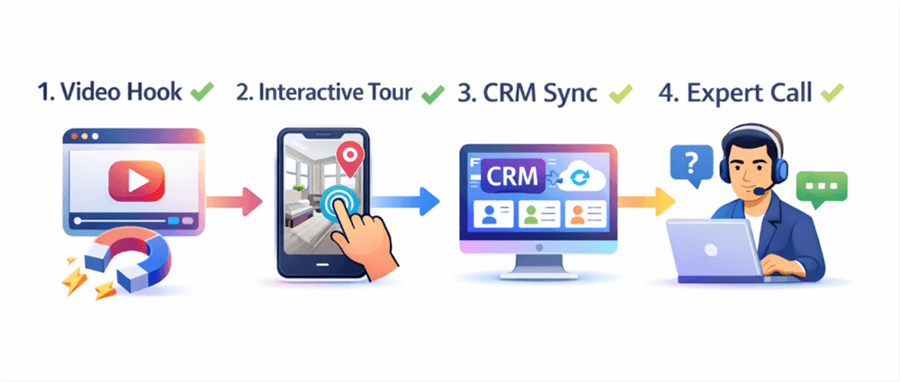
SaaS Marketing Funnel Checklist
By gating live access behind these educational steps, you ensure that your sales engineers only speak to educated buyers who ask specific, high-value questions. This shift moves your team from being “tour guides” to being strategic consultants.
Metrics and Integration: Solving the Data Silo
Implementing on-demand demos fails if the data lives in a silo. If your sales team doesn’t know who watched the video or who clicked through the tour, they cannot prioritize their outreach.
To evaluate your new strategy effectively, you must track three KPIs and ensure they flow into your revenue operations:
1. Completion Rate & Drop-off Points
For your FocuSee videos, check where viewers stop watching. If 60% of viewers drop off at the 30-second mark, your content is likely too slow.
Integration: Use video hosting platforms that support engagement tracking, or include the FocuSee video in a tracked email sequence to monitor click-throughs.
2. Engagement Time (The Intent Score)
For interactive demos (Navattic/Storylane), measure how long a user spends exploring.
Integration: This is the most critical technical step. Configure a workflow where a “Demo Completed” event triggers an alert in Slack or creates a task in Salesforce for the assigned account owner.
The Benefit: A sales rep calling a prospect 10 minutes after they finished a product tour has a drastically higher success rate than a cold outreach.
3. Post-Asset Conversion Rate
This is your ultimate ROI metric. Track the percentage of users who book a meeting immediately after interacting with your self-serve asset.
Optimization: If this number is low, your asset might be answering too many questions, leaving no curiosity gap, or your Call to Action (CTA) might be unclear.
Conclusion
The bottleneck in your sales cycle isn’t a lack of leads; it’s the friction required to process them. Relying solely on live calls when prospects want immediate answers hurts both your team’s morale and your conversion rates. By adopting alternatives to live demos for SaaS marketing, you give your buyers the autonomy they crave while preserving your team’s time for high-impact conversations.
This is not about removing the human touch—it is about respecting your prospect’s time. You can start this transition today with low risk:
- Audit your most repetitive intro call.
- Record a polished, zoom-enhanced version using FocuSee.
- Build a hands-on layer using a tool like Navattic or Storylane.
- Connect the data to your CRM so your team knows exactly when to strike.
You will likely see an immediate improvement in the quality of conversations your team has next week.