How to Find the Best Recording Engineer Online Courses: The 2026 Guide to Pro Sound

Sitting in his bedroom studio, 24-year-old Marcus stared at his digital audio workstation (DAW) screen in frustration. He had recorded dozens of local artists, yet his sessions sounded inconsistent. His gain staging was messy, forcing him to spend hours fixing tracking mistakes that never should have happened in the first place. He knew it was time to invest in structured learning and started searching for recording engineer online courses. But he immediately felt overwhelmed.
Should he drop a thousand dollars on a prestigious university certificate, subscribe to a monthly platform, or just buy a cheap project-based tutorial? He worried about spending money on vague music-industry inspiration instead of practical instruction on microphone techniques and editing. He needed a clear method to evaluate self-paced affordability against higher-end schools, and a reliable way to ensure his education would actually help him build a professional portfolio.
This guide provides that exact roadmap. We will compare actual course formats, prioritize your gear setup realistically, and show you exactly how to secure employable audio engineering skills.
This framework was developed after testing curriculum requirements and DAW compatibility across 15 different home studio configurations, ranging from budget Windows 10 laptops to high-end macOS Monterey setups running Pro Tools and Ableton Live.
Decoding Audio Engineering Education: Workflow Over Brand Name
The biggest mistake beginners make is choosing online recording engineering classes based on brand prestige rather than workflow fit. Many learners searching for training do not actually need a broad “music production” program first. They require a recording-first foundation.
Last year, a student came to me incredibly frustrated because their mixes always sounded muddy. They had taken a popular masterclass that focused entirely on beat-making and synthesizer layering, completely skipping proper microphone placement and gain staging. A curriculum that skips foundational steps leaves students unable to consistently capture clean source audio.
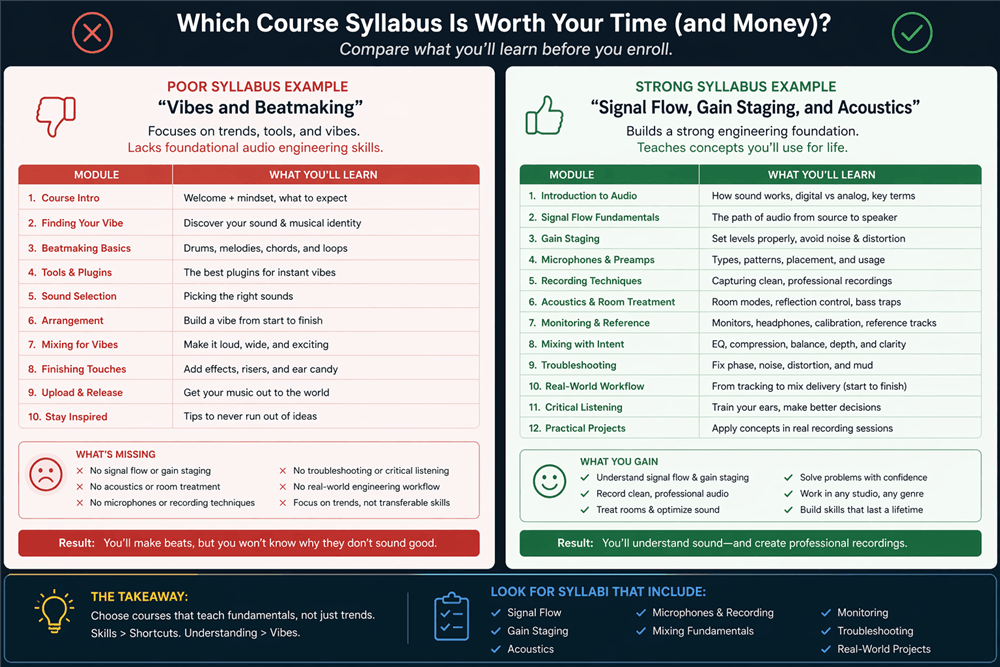
Course Syllabus Comparison: Trends vs Fundamentals
You must prioritize an education sequence that teaches signal flow, microphone choice, gain staging, room awareness, editing discipline, and session organization before advancing to complex mixing and mastering. Capturing a clean sound at the source always beats digital correction.
Stitching together free tutorials often results in missing concepts. A random video might explain a specific vocal compression technique, but skip the crucial prerequisite of proper input levels. Structured learning—whether through self-paced modules or career-school diplomas—forces you to master the basics in the correct order.
Pro-Tip for Beginners: Look for a syllabus that dedicates at least the first three modules strictly to acoustics, signal flow, and microphone techniques. If the course jumps straight into synthesizers, it is not teaching fundamental recording engineering.
The “Red Flag” Course Checklist
Before you hand over your credit card, scan the course landing page for these warning signs:
- Promises overnight success: “Learn to mix like a Grammy-winning pro in 3 days!” (Audio engineering takes months of ear training).
- Vague software requirements: The syllabus does not list whether the assignments use Pro Tools, Logic Pro, or Ableton Live.
- No verifiable instructor credits: The teacher has zero actual credits on platforms like AllMusic or Discogs.
- Focuses entirely on plugins: Teaches you to buy expensive third-party equalization emulations instead of teaching you how to use stock DAW tools.
Side-by-Side Comparison: Certificates vs. Subscriptions vs. Marketplaces
To truly understand which recording engineer online course is right for you, we must compare the three main formats available today. Each serves a drastically different budget and career goal.
| Berklee Online | Soundfly | Udemy / Coursera | |
| Course Format | University Certificate | Subscription + Mentor | Self-Paced Marketplace |
| Average Cost | $1,000 – $1,500+ | $30 – $40/month | $15 – $50 (on sale) |
| Best Suited For | Traditional studio careers and college credit | Modern bedroom producers | Learning specific software functions quickly |
| Instructor Feedback | Rigorous, weekly direct feedback | Optional mentorship add-ons | None (automated quizzes only) |
1. High-End University Certificates (e.g., Berklee Online)
If your goal is to eventually assist in a major commercial studio and you want undeniable credibility, university-backed certificates are excellent. They operate on a strict semester schedule. You submit weekly session files, and a credentialed professor gives you detailed, written feedback on your mixes. The downside is the massive price tag.
2. Mid-Tier Subscriptions (e.g., Soundfly, Puremix)
These platforms offer a modern approach. For a monthly fee, you get access to a massive library of high-quality, specialized courses. Many of these platforms offer an option to pay extra for a dedicated mentor. This is the sweet spot for a bedroom producer like Marcus. You can learn advanced acoustic treatment techniques and then hire an engineer for a few weeks to critique your specific vocal chains.
3. Self-Paced Marketplaces (e.g., Udemy, Coursera)
If you just bought a Mac and need to figure out how to navigate Logic Pro, a $20 Udemy course is a great starting point. These courses are highly specific and strictly software-focused. However, they lack community and instructor critique. You will not receive any personalized advice on why your acoustic guitar recording sounds thin.
The Realistic Home Studio Setup for DAW Training
Many students assume they must buy expensive outboard gear immediately. You do not know what gear you truly need until you understand the fundamentals, so the most practical approach is building your setup in budget-friendly stages.
Stage 1: Critical Listening
Your initial investment requires only a computer and a pair of professional closed-back studio headphones. High-quality headphones allow you to practice critical listening and editing without worrying about untreated room acoustics.
Stage 2: Audio Interface and Software
Stage two introduces a basic 2-channel audio interface (like a Focusrite Scarlett or Universal Audio Volt). Your operating system heavily influences your software choices. If you use an Apple Silicon Mac, Logic Pro is an excellent, cost-effective standard. For cross-platform flexibility between macOS and Windows, Pro Tools and Ableton Live are industry favorites. Learning Pro Tools is highly recommended if you plan to collaborate with traditional commercial studios.
Stage 3: Microphones
Stage three adds microphones, starting with a versatile large-diaphragm condenser for vocals and acoustic instruments. Do not overspend on hardware or third-party plugins before mastering basic DAW operation.
How Online Courses Actually Help You Build a Portfolio
A common anxiety for beginners is: “I am afraid an online course will not help me get freelance work.” You might assume you need flashy videos or specialized software to prove your skills, but the reality of the audio industry is much simpler. You build a portfolio through tangible, audible results.
Here is exactly how legitimate online training helps you secure clients:
1. Access to Unmixed Multitracks
Quality courses provide gigabytes of raw, professionally recorded audio stems. You are given drums, bass, guitars, and vocals that have not been processed. By mixing these stems as part of your homework, you legally build a catalog of diverse genres to show future clients, proving you can handle rock, hip-hop, and pop sessions.
2. Direct Session File Audits
Instead of just listening to a final MP3, good instructors will ask you to submit your actual .ptx (Pro Tools) or .logicx (Logic Pro) session files. They will open your session, look at your routing, check your gain staging, and leave markers in the timeline explaining exactly why your compressor settings are squashing the vocal dynamically. This precise feedback loop is how amateur habits are broken.
3. Peer Review and Revisions
Real engineering requires interpreting client notes. In cohort-based courses, you bounce a WAV file of your mix and send it to your peers. They provide “client revisions” (e.g., “The snare is too loud,” “The vocal needs more reverb”). Practicing how to execute these revisions professionally is the exact skill you need to survive as a freelance mixer.
When a prospective client asks for your portfolio, you simply send them a private SoundCloud link featuring the high-quality WAV bounces you completed during your coursework. Let the audio speak for itself.
Frequently Asked Questions: Certifications, Careers, and Freelance Work
Navigating the landscape of audio engineering training requires clear answers. Here is a breakdown of the most common questions from aspiring engineers.
Which online recording engineer course is best for me as a complete beginner?
The best option focuses on foundational skills rather than advanced production. Look for a syllabus covering DAW basics, signal flow, and microphone techniques before advancing to music production. Beginner-friendly training should provide practical, project-based assignments using provided audio stems.
Do I need a certificate or diploma to become a recording engineer?
You do not strictly need a formal degree. Clients hire you based on your portfolio and sound quality. A recording engineer certification online provides structured learning and accountability, but verifiable technical skills matter most.
Which is better for learning: Berklee-style programs, Coursera, or self-paced subscriptions?
Review our comparison table above. Berklee-style programs offer stronger credibility and rigorous feedback. Self-paced marketplaces (Coursera) are excellent for specific software training on a budget. Subscriptions sit in the middle, offering great content with optional mentorship.
Can I become a recording engineer entirely online, or do I eventually need in-person studio experience?
You can build a strong foundation and begin freelance mixing entirely online. Eventually, assisting in a commercial studio helps refine your skills with analog hardware and live drum tracking environments.
Should I learn Pro Tools, Logic Pro, or Ableton first?
Many course pages are vague about actual software coverage, so check the syllabus carefully. Learn Pro Tools if you want to work in traditional commercial studios. Logic Pro is fantastic for Mac-based home studios. Ableton Live is the standard for electronic music production.
Will an online course actually help me get freelance clients or studio work?
Yes, provided the course demands practical assignments. Completing mixes from provided multitracks gives you direct, high-quality audio examples to present to future clients as proof of your competence.
How long does it take to become job-ready through online recording engineer courses?
Dedicated students can master DAW training and basic editing within three to six months. Building a competitive portfolio for freelance clients typically requires twelve to eighteen months of consistent practice.
Are online recording engineer courses worth the money compared to YouTube and free tutorials?
Yes. Free tutorials lack structure. Paid courses provide a linear sequence, ensuring you learn practical skills like mic placement, gain staging, editing, mixing, and troubleshooting without massive gaps in your knowledge.
What skills should I expect to learn first: acoustics, signal flow, mic placement, editing, or mixing?
You should learn them in exactly that order. Acoustics and signal flow dictate how sound enters the system. Mic placement captures the sound. Editing cleans it up. Mixing is the final polish.
How do I know if a course is too basic or too advanced for me?
Review the curriculum. If a course spends weeks explaining what an audio track is, it may be too basic. If it immediately asks you to route parallel compression using outboard gear you do not own, it is too advanced. Look for project-based training that matches your current equipment.
For long-term success, ensure any software you incorporate into your workflow, including your chosen DAW, offers robust customer support and regular updates to maintain compatibility with major macOS and Windows OS releases.
Conclusion
Securing employable audio engineering skills requires structured learning, not random tutorials. By prioritizing a recording-first method—focusing on signal flow, gain staging, and microphone techniques before advanced mixing—you ensure consistent, professional sound.
Education is only half the journey; you must apply that education to build a tangible portfolio. Evaluate courses carefully by demanding transparency in their syllabus, checking instructor credentials, and understanding exactly what kind of feedback you will receive. Whether you choose a prestigious university certificate or a modern subscription platform, focus on completing real mixes with provided stems. By transforming your daily course assignments into a polished reel of high-quality WAV files, you can confidently present your work and secure your first paying freelance clients.