Social Media Video Marketing: The Playbook for Predictable Growth in 2026

If you manage a brand’s social media, you know the pressure to deliver results with video. A video that takes hours to create can fall flat, while a spontaneous one goes viral, leaving you with inconsistent outcomes and strained resources. This isn’t a sustainable way to grow. This guide moves beyond chasing trends to provide a repeatable system for video marketing on social media that delivers predictable results.
We’ll follow the real-world example of Mateo, a Social Media Lead who transformed his brand’s performance by replacing guesswork with a systematic approach, increasing trial sign-ups by 24% in six weeks. His journey provides the practical framework for your own social video marketing strategy.
The Hook-Variant Playbook: A 4-Step System for Consistency
The most common reason for inconsistent video performance is a failure to optimize the first two seconds. Most marketers create one video and hope it performs. A better method is to treat the hook—the first 1-2 seconds of your video—as a separate, testable asset. Instead of creating one video, you create one core video body with multiple, distinct beginnings. This technique of A/B testing hooks is the most direct way to improve performance.
Here is the four-step procedure Mateo followed:
1. Define Content Pillars and a Simple Calendar:
First, Mateo established three core topics his audience valued: workouts, nutrition tips, and member success stories. He then mapped these pillars to a weekly calendar to ensure a consistent mix of content. This gave structure to his social video content calendar and ensured every video was relevant.
| Day | Content Pillar | Funnel Stage | Goal |
| Monday | Workout Tip | Awareness | Provide quick, shareable value. |
| Wednesday | Nutrition Tip | Awareness | Educate and build authority. |
| Friday | Member Success Story | Consideration | Build social proof and trust. |
2. Script One Core Video Body:
For a single topic, like a 30-second workout tip, he would script and produce one main video body, from the three-second mark to the end.
3. Generate 3-5 Hook Variants:
For that single video body, he created 3-5 different openings. One might start with a direct question (“Are you making this common workout mistake?”), another with a bold statement (“This one move is better than 100 crunches”), and a third with a surprising visual.
4. Soft-Test and Validate:
This is the most critical step. He ran a small, controlled test to find a winning hook with a 3-second hold rate of 65% or higher *before* posting the video organically. This data-driven step is what separates a predictable strategy from guesswork.
How to Test Your Hooks: A Step-by-Step Guide
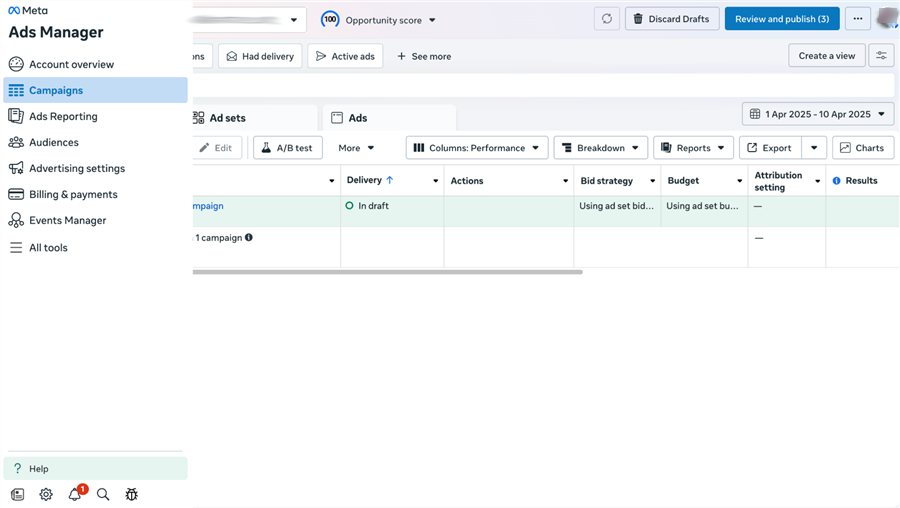
Most advice stops at “test your videos,” but here’s the exact process for validating hooks with a small, controlled budget using Meta Ads Manager.
1. Set Up a Test Campaign
Create a new campaign with the Engagement → Video Views objective and optimize for ThruPlay so Meta finds users likely to watch at least 15 seconds.
2. Create Your Ad Sets
Make one ad set per hook variant. Keep the same audience and budget for all sets to ensure a fair test. A broad audience (e.g., US, 25–45, fitness interest) and $20–$50 per ad set for 24–48 hours is enough for validation.
3. Upload Your Ads
Each ad set should use the same video body, thumbnail, and copy, with only the first 1–2 seconds (the hook) changed.
4. Analyze the Results
Ignore likes and comments. Focus on the 3-second video play rate (3-second plays ÷ impressions). The highest-performing variant—ideally 65%+—is your winner. Post that version organically.
This system removes guesswork and helps you build a library of proven hooks, making short-form growth more predictable.
Meta Ads Manager
Choosing Your Production Workflow
Executing the Hook-Variant Playbook requires a consistent production process. The primary decision you face is whether to build a manual workflow using general-purpose editing tools or adopt a specialized platform.
A manual workflow using tools like Adobe Premiere Pro or CapCut gives you complete creative control. This is a good option if you have a skilled editor on your team with the time to produce multiple variants, add captions, manage music licenses, and resize for each platform. The main challenge is the time investment; an experienced editor might spend 2-4 hours on a single video, and creating 3-5 hook variants multiplies that effort.
An AI-assisted platform is designed for speed and consistency. These tools are built for marketers, not professional editors, and handle the technical complexity of video production. They automate time-consuming tasks like captioning, scripting hook ideas, and resizing for the vertical 9:16 aspect ratio. This approach reduces the risk of compliance issues by providing libraries of commercially licensed music.
The right choice depends on your team’s skills, budget, and desired output volume.
How to Accelerate Your Social Media Video Workflow with FocuSee
For a small team or a solo creator like Mateo, producing enough hook variants to run proper A/B tests can feel impossible. The real bottleneck isn’t creativity—it’s the operational workload. This is where a purpose-built tool makes all the difference.
FocuSee is an AI-powered video creation and editing platform designed specifically for social-media-ready content. Unlike general editing software, it optimizes the entire workflow around speed, consistency, and multi-platform delivery—so creators can publish more high-performing videos with less manual work.
Here’s how FocuSee streamlines each step of the workflow:
AI Edit & Finishing:
FocuSee eliminates the most repetitive editing tasks, from adding autoplay-friendly captions to cleaning up the timeline. It automatically identifies and removes silences, filler words, and dead air, producing a tighter and more engaging cut without manual trimming.
Multi-Platform Auto Resizing:
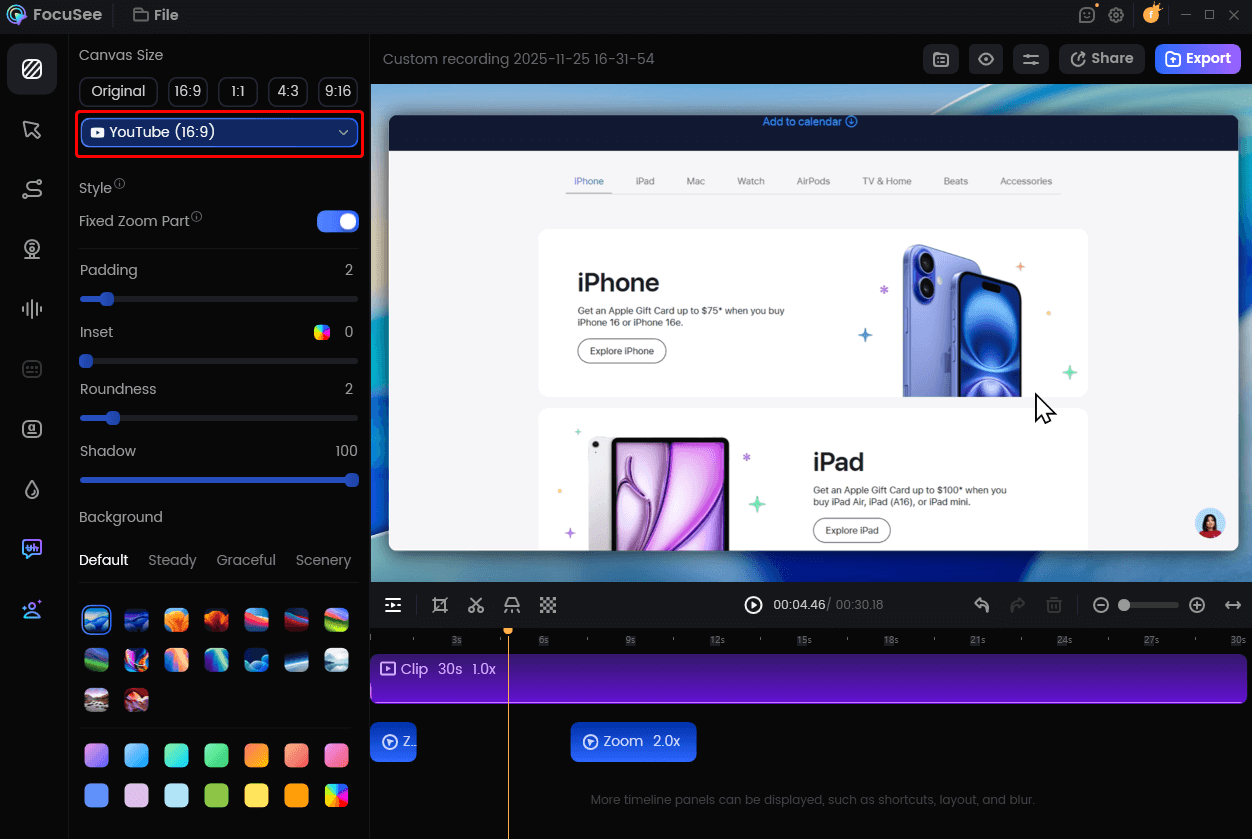
Instead of recreating the same video for each platform, FocuSee instantly adapts your master edit into perfectly sized versions—16:9 (YouTube), 4:3 (Facebook), 1:1 (Feed), and 9:16 (TikTok/Reels/Shorts). This ensures every upload fits the platform’s best-performing format.
Change Video Size for YouTube
Automatic Subtitle Generation:
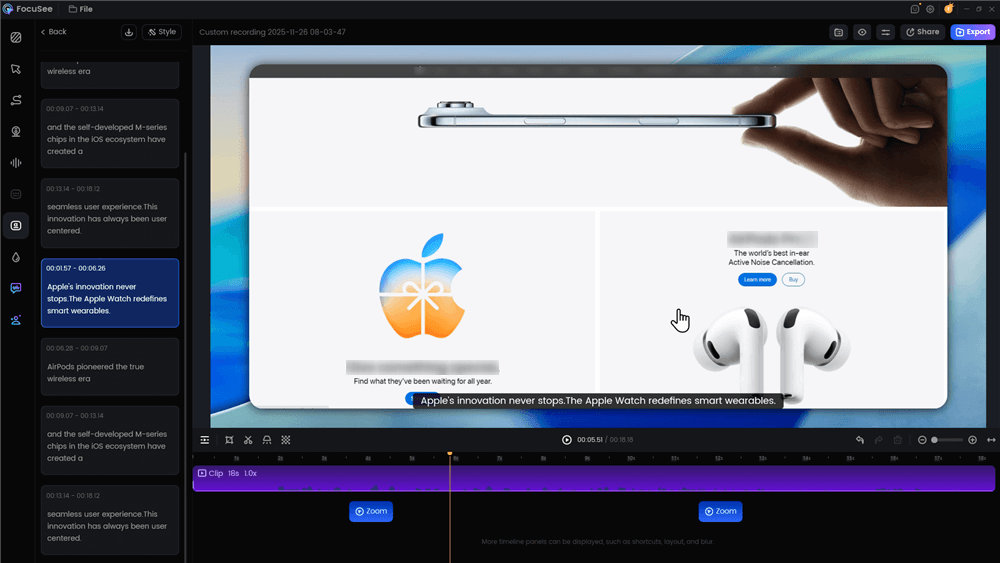
Subtitles are essential for social feeds where up to 80% of viewers watch on mute. FocuSee generates accurate, stylized subtitles in 50+ languages with one click, fully optimized for autoplay behavior on TikTok, Reels, and Shorts.
Automatic Subtitle Generation
Branding Consistency with Custom Watermarks:
To maintain a unified brand identity across all variants, FocuSee lets you upload your logo and apply a consistent watermark to every output. This removes the need to manually add branding during the export phase.
Platform-Specific Best Practices for Social Media Video
A winning video concept must be adapted to each platform’s environment. While the vertical 9:16 aspect ratio is standard, audience expectations and algorithm behaviors differ. A successful TikTok and Reels marketing strategy will not perform optimally on LinkedIn without key adjustments.
Here are the key technical specifications and actionable creative formulas for 2025 in the US market.
| Metric | TikTok | Instagram Reels | YouTube Shorts | LinkedIn Video |
| Ideal Length | 21-34 seconds | 15-30 seconds | 45-59 seconds | 30-90 seconds |
| Aspect Ratio | 9:16 | 9:16 | 9:16 | 9:16 (In-Feed) or 1:1 |
| Target 3s Hold Rate | ≥70% | ≥65% | ≥60% | ≥55% |
| Target Completion Rate | ≥40% | ≥35% | ≥50% (for longer format) | ≥30% |
An essential technique for LinkedIn video marketing for B2B is to account for silent, in-feed autoplay. You must front-load value with prominent on-screen text in the first frame and use burned-in (open) captions throughout.
Measuring Success and Scaling with Paid Advertising
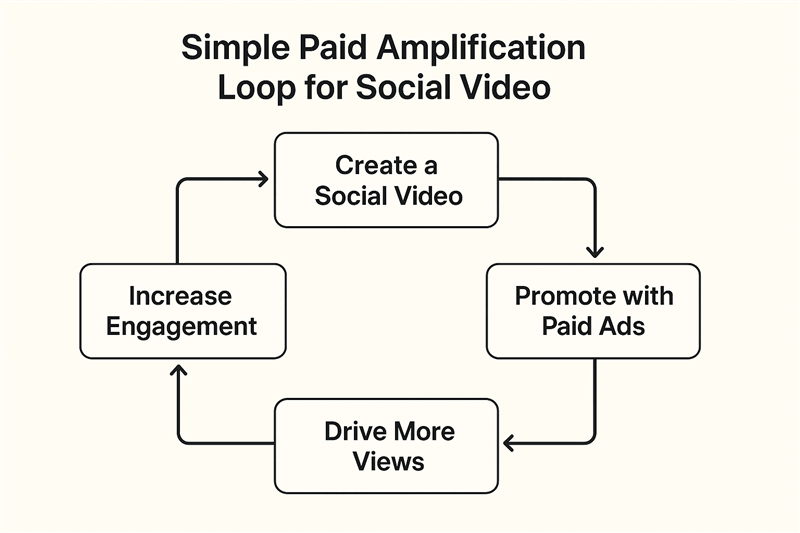
Organic content is the foundation, but a paid social media video advertising strategy is necessary to guarantee reach and drive conversions. The key is to amplify what already works. Your hook testing already proves which videos have the highest engagement potential.
Simple Paid Amplification Loop for Social Video
Your social video metrics and KPIs should align with your business goals:
- Top of Funnel (Awareness): Focus on View-Through Rate (VTR) and Cost Per View (CPV). The goal is efficient, broad-reach engagement.
- Middle of Funnel (Consideration): Track Click-Through Rate (CTR) and average watch time. This indicates the audience is interested enough to learn more. [Internal Link Suggestion: Link the preceding phrase to ‘/blog/how-to-increase-ctr-on-social-media’]
- Bottom of Funnel (Conversion): Measure conversions (e.g., sign-ups, purchases) and Cost Per Acquisition (CPA).
Mateo followed a simple paid amplification loop. First, he identified organic videos with high completion rates (over 38%). He then allocated a $6,000 budget to boost these posts using an engagement objective. This built a warm audience of people who had watched his best content. Finally, he created a retargeting campaign that served a direct offer video to that audience, resulting in his 24% increase in trial sign-ups.
Conclusion
Inconsistent video performance is not a personal failure; it is the result of an unreliable process. The solution is to adopt a deliberate, data-driven framework. The Hook-Variant Playbook provides a clear method for creating content that resonates, while a tool like FocuSee provides the efficiency to execute that strategy without overwhelming your resources.
You can move from hoping for success to building it systematically. Take this framework, test your next set of hooks, and start generating the predictable outcomes your brand deserves.
FAQs on Social Media Video Marketing
What are the ideal lengths and aspect ratios for each platform?
Ideal lengths vary, from 21-34 seconds on TikTok to 30-90 seconds on LinkedIn. However, the standard for most short-form video is a vertical 9:16 aspect ratio with captions designed for silent viewing. For a detailed breakdown of 2025 benchmarks, see the data table in the platform-specific section above.
How do I script strong hooks that increase retention?
The most effective method is to treat the first 1-2 seconds as a testable asset. Script 3-5 hook variations for each core video and validate them with a small paid test to identify which version achieves the highest 3-second hold rate (aim for 65%+). The complete step-by-step procedure is detailed in the testing section.
What benchmarks should I aim for in 2025?
For 2025 in the US market, target a 3-second hold rate of 65-70%+ on entertainment platforms like TikTok and 55%+ on professional platforms like LinkedIn. Completion rates for sub-30-second videos should be 35-40%+. A good CTR is typically 1-2%. Specific targets are listed in our benchmarks table.
When should I use paid advertising for a video?
You should apply paid spend to your top-performing organic videos. Identify content that has already proven its effectiveness with high engagement and completion rates. Start with an engagement or video views objective to build a warm audience, then retarget that audience with a conversion-focused ad. This two-step process is explained in the section on measurement.
What tools help a small team produce video consistently?
A small team’s primary challenge is the time cost of manual production. AI-powered platforms like FocuSee are designed to solve this by automating repetitive tasks like scripting hook variants, adding captions, resizing videos, and ensuring music is commercially licensed.
How do I legally use music and creator content?
To avoid copyright strikes, use music from a commercially licensed library, which is often included in professional video platforms. For user-generated content (UGC) or creator collaborations, always secure explicit permission through a formal agreement that outlines usage rights, duration, and compensation. This is a critical step for brand safety.