SaaS Content Marketing: A Revenue-First Framework for 2025

If you are running B2B SaaS content marketing today, the following scenario might feel uncomfortably familiar. Meet “Chris,” a lead marketer at a Series A SaaS company. For six months, Chris’s team has published high-quality, top-of-funnel blog posts. The analytics look impressive—traffic is climbing steadily to the right. Yet, the sales Slack channel is silent. Demo requests haven’t moved, and the few leads coming in are unqualified.
Chris is stuck in the “Vanity Trap”: high traffic, zero revenue impact.
You need a SaaS-specific approach, not generic advice that prioritizes volume over intent. This guide outlines the exact operational blueprint used to escape that trap. It is based on a review of successful content engines in the US mid-market and hands-on testing of production workflows. The core thesis is simple: standard traffic-chasing fails because it prioritizes eyeballs. To drive pipeline, you must adopt a “BOFU-first” approach, building the assets that convert before you build the assets that attract.
The Inverted Strategy: Building a Content-to-Revenue Architecture
Most standard advice suggests starting with broad, educational content to “build awareness.” In SaaS, this is often a resource drain. The fastest way to make a SaaS content marketing framework produce pipeline is to “invert the funnel.” You must treat Bottom of Funnel (BOFU) pages as your core product surfaces, not merely as supporting blog posts.
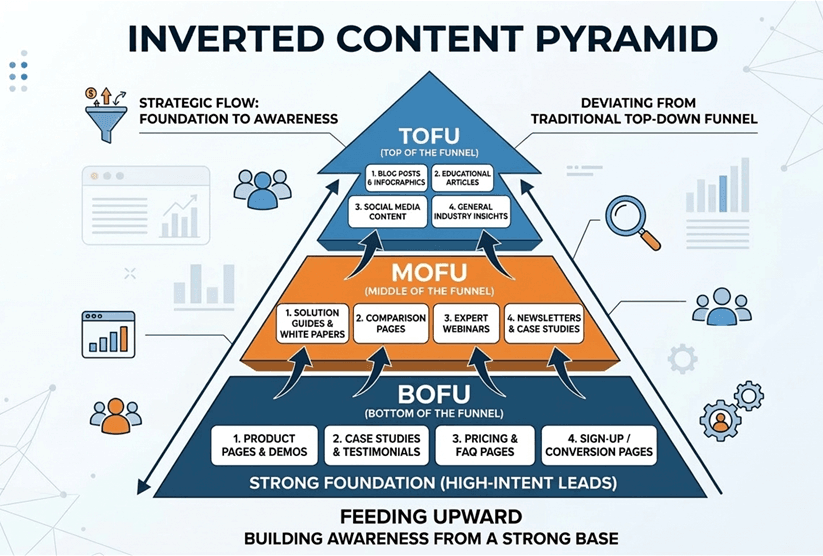
Inverted Content Pyramid
The Expert Insight: Build the BOFU Cluster First
To correct the low-conversion issue, you must pause generic blogging and build a BOFU cluster. This foundation includes three specific types of high-intent pages:
- Alternatives Pages: These capture traffic searching for “[Competitor] alternatives.” These users are already educated and looking to switch.
- Comparison Pages: Direct “Us vs. Them” breakdowns that honestly evaluate features.
- Integration Pages: Capturing traffic looking for tools that fit their existing stack (e.g., “Best Slack CRM”).
Only once these high-intent nodes exist should you build MOFU (Middle of Funnel) and TOFU assets. The sole purpose of your educational blog posts is to route users into these BOFU nodes via internal linking and offer ladders.
GTM Decision Tree: ACV and Methodology
Your SaaS content marketing strategy must align with your Go-to-Market motion. However, simply choosing between “Sales-Led” or “Product-Led” isn’t enough. You must also account for Average Contract Value (ACV), as this dictates the depth of your content.
- Low ACV (<$5k/year) & PLG:
- Goal: Self-serve conversion.
- Content Role: The content is the salesperson.
- Focus: “How-to” technical content that leads directly to a free trial or signup. Solve an immediate problem using your tool’s specific features.
- High ACV (>$25k/year) & Sales-Led:
- Goal: Demo Request or Discovery Call.
- Content Role: Sales enablement.
- Focus: Strategic methodology, risk mitigation, and ROI arguments. Your content must equip an internal champion to sell your solution to their CFO.
- The Hybrid “Mid-Market” Trap:
- Goal: Qualified Lead (MQL/PQL).
- Content Role: Trust building.
- Focus: If you sit in the middle ($5k–$25k), your content needs to bridge the gap. You need public pricing pages and deep feature comparisons (PLG style), but with the reassurance of enterprise security and support (Sales-Led style).
Execution: The High-Intent Wireframe Checklist
Knowing what pages to build is step one. Knowing how to structure them for conversion is step two. Do not treat a Comparison Page like a standard blog post. It requires a specific architecture to win the argument.
The Comparison Page Wireframe (5-Point Checklist)
Use this structure for every “Us vs. Them” page to maximize conversion:
The ‘At a Glance’ Table:
- Place this above the fold.
- Do not use simple checkmarks. Use text labels (e.g., “Native Integration” vs. “3rd Party Plugin”) to highlight specific differentiators immediately.
The ‘Where We Win’ Deep Dive:
- Select your top 3 “Killer Features.”
- Don’t just write about them—show them. This is where you embed a micro-demo or product video (more on this below).
The ‘Where They Win’ Concession:
- Be honest. If a competitor has a better enterprise API, admit it.
- This builds the “Trust Layer.” Users know no tool is perfect; admitting weaknesses makes your strengths believable.
The Switcher ROI Calculator:
- For the champion pitching this to a boss: “By switching, you save X hours or Y dollars.”
The Proof Video:
- A 60-90 second uninterrupted walkthrough of your platform solving the core use case.
The Trust Layer: Differentiation in an AI Era
With AI content flooding the SERPs, text is no longer enough to convert. Buyers are skeptical of marketing claims. You must add a “Trust Layer” to every BOFU page using proof points:
- Original Data: Proprietary benchmarks or survey results.
- Expert POV: Quotes from your internal subject matter experts, not generic advice.
- Product Evidence: This is the most critical element. Modern SaaS buyers need to see the product working before they commit to a call.
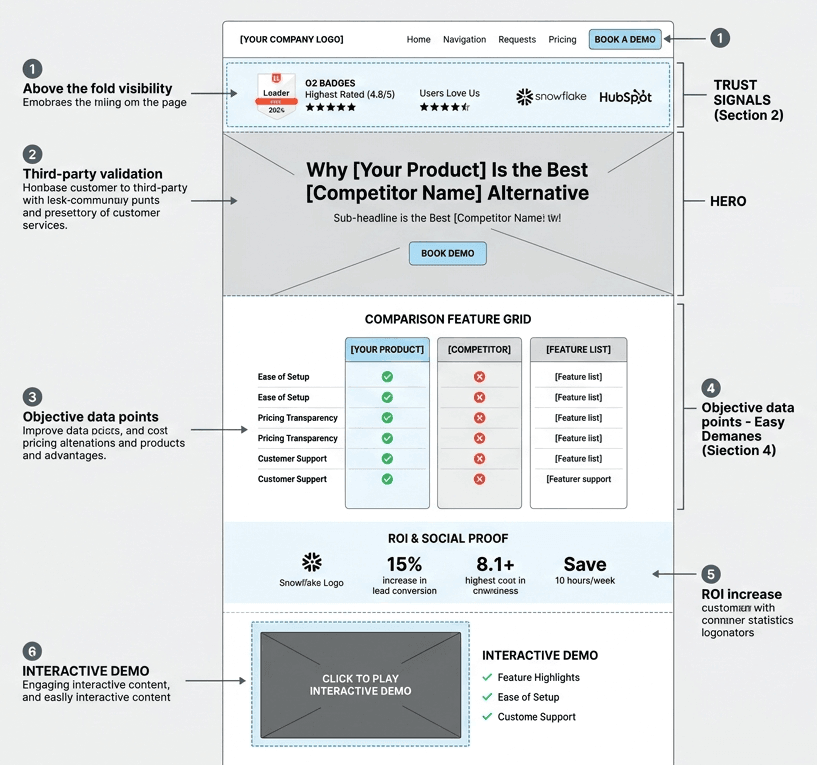
A SaaS Content Marketing Alternatives Page – 1
If your comparison pages only contain text tables, you will lose to competitors who show interactive demos and video walkthroughs. You must prove your software works as claimed.
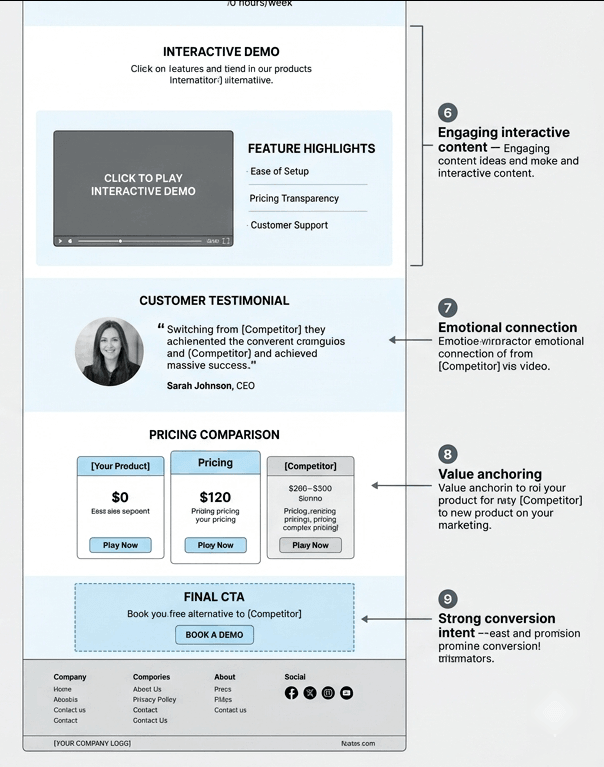
A SaaS Content Marketing Alternatives Page – 2
Production Reality: Solving the “Proof Gap”
Recognizing the need for product-led content marketing is easy; executing it is hard. Most teams hit a production bottleneck here. They know they need video on their Comparison Pages, but they lack the resources to create visual proof assets at scale.
This creates a “Proof Gap.” You have the strategy, but your pages remain static text blocks because recording, editing, and polishing product videos takes too long or costs too much.
The Old Way: Static & Manual
This approach relies on text-heavy explanations supported by static screenshots. While easy to produce, static images fail to show workflow fluidity. When teams attempt video manually, they face significant friction: manually editing out sensitive admin data (PII), smoothing out jittery cursor movements, and attempting to zoom in on key buttons requires hours of post-production.
The New Way: Automated Polish
To close the Proof Gap without hiring a video agency, you need tools that automate the post-production process. This is where FocuSee fits into the SaaS content marketing plan. It acts as the production engine for your BOFU assets.
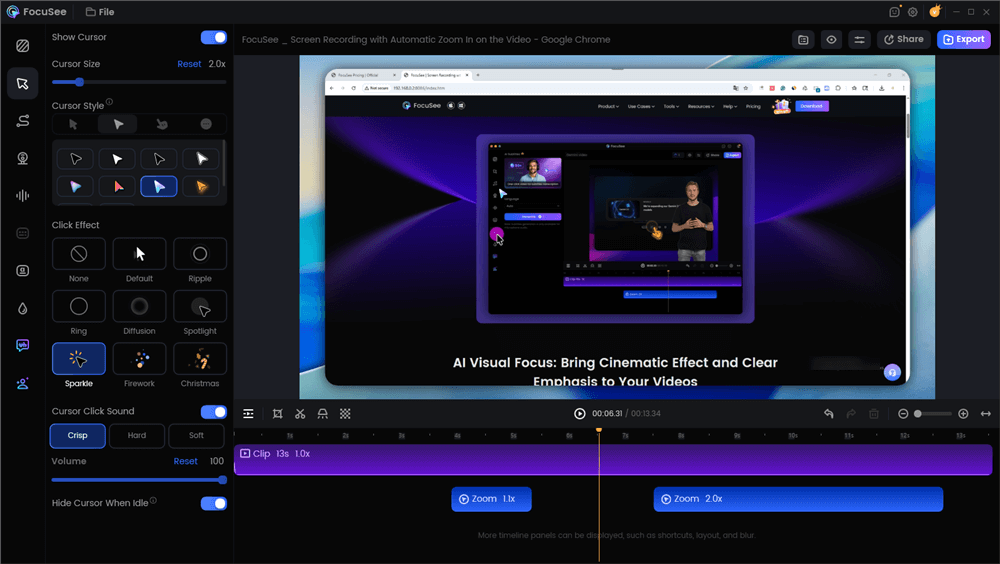
FocuSee Interface Overview
We are not talking about “features” here; we are talking about output.
- Before FocuSee: A static screenshot on a landing page labeled “Easy Reporting.” The user has to trust you.
- After FocuSee: An auto-playing video that zooms in on the cursor clicking “Generate Report” and the data populating instantly. The user sees the speed.
Scaling Asset Creation with FocuSee
To implement this strategy without a dedicated video team, FocuSee automates the polish of screen recordings. Here is how it impacts your content operations:
1. The “Stop the Scroll” Effect (Auto-Zoom)
In a standard recording, complex SaaS dashboards look cluttered on mobile screens. FocuSee automatically tracks cursor movement and applies dynamic zooms. This mimics the editing style of professional tech YouTubers, keeping the viewer’s eye focused on the specific feature you are pitching.
2. Compliance Speed (Privacy Blur)
Creating demos often exposes sensitive admin data or client names. Instead of frame-by-frame masking in Premiere Pro, FocuSee allows you to blur sections in seconds. This removes the security bottleneck that often prevents marketing teams from publishing product views.
3. Multi-Channel Output
Distribution is weak if content lives only on a blog. FocuSee enables export to different aspect ratios (vertical for TikTok/Shorts, landscape for YouTube/LinkedIn) without re-recording. This fuels your saas content distribution strategy by providing native assets for every platform from a single take.
This is a SaaS marketing video made by FocuSee with auto-zoom and cursor spotlight.
Distribution: The “Sales Enablement Hand-off”
Do not let your assets die on the blog. “Sending it to sales” is not a strategy; it is a wish. You need a formalized Minimum Viable Distribution loop.
1. The “Snippet Strategy” for SDRs
Sales Development Reps (SDRs) live in LinkedIn DMs and email. Make it easy for them to use your new BOFU video.
- The Tactic: Create a Text Expander (or snippet tool) shortcut.
- The Content: A pre-written 2-sentence hook + the direct link to the specific comparison video.
- The Result: An SDR types ;vid-competitor and instantly populates a message: “Hey [Name], I saw you’re using [Competitor]. A lot of our users switched because of their reporting limits. Here is a 45-second video showing exactly how we handle that differently: [Link].”
2. Centralized “Truth” Repository
Store these assets where sales actually works—not in a Google Drive folder they will never open.
- The Tactic: specific “Battlecards” in Notion, Guru, or Highspot.
- The Content: Embed the FocuSee video directly into the “Competitor X Battlecard” so the AE can pull it up live during a Zoom call to handle objections.
Measurement: Moving Beyond Vanity Metrics
The final piece of the architecture is the feedback loop. Leadership asks what revenue content generated, and marketers often point to pageviews. You must shift your reporting to pipeline influenced.
Here is the 3-step technical primer to tracking this in GA4:
Step 1: Create the Custom Event
You need to know if people are actually watching your proof assets. Set up a custom event in GA4 (via Google Tag Manager) that triggers when a visitor watches more than 50% of your embedded product video.
- Event Name: product_video_progress_50
Step 2: Mark as a “Key Event”
In GA4 admin settings, mark this specific video event as a “Key Event” (formerly Conversion). This allows you to bid against it in paid campaigns and track it specifically in reports.
Step 3: The Path Exploration Report
Stop looking at aggregate bounce rates. Go to Explore > Path Exploration.
- Starting Point: Select your specific BOFU page (e.g., “/alternatives-to-competitor”).
- Next Step: Look for your product_video_progress_50 event.
- Goal Step: Look for demo_request_submit.
- Insight: This report tells you: “Of the people who landed on our Comparison page, did watching the video increase the likelihood of them booking a demo?”
[Image Placeholder]: A ‘Content-to-Pipeline’ dashboard mockup showing leading indicators (scroll depth, video plays) flowing into lagging indicators (demo requests, SQOs). Alt-text: Dashboard showing saas content marketing metrics like pipeline influenced.
Conclusion
The “Vanity Trap” of high traffic and low revenue is not a permanent state; it is a symptom of a misaligned strategy. By shifting from a generic blogging model to a revenue-first SaaS content marketing framework, you stop guessing and start converting.
Your path forward is clear: Audit your existing content, prioritize the creation of high-intent BOFU pages using the 5-point wireframe, and infuse them with the “Trust Layer” using product evidence. You do not need a Hollywood studio to create these assets. With tools like FocuSee, you can capture, polish, and publish professional product videos in minutes, giving your buyers the proof they need to click “Book Demo.”
Frequently Asked Questions
What is SaaS content marketing, and how is it different?
SaaS content marketing focuses on the software buying cycle, which is often longer and involves multiple stakeholders. Unlike general content marketing, it emphasizes activation and retention, not just acquisition. It requires technical accuracy and product-led evidence (demos, trials) to win trust.
How do I build a SaaS content marketing plan that drives demos?
Start by identifying your high-intent keywords (Comparison, Alternatives, Integration). Build these BOFU pages first, ensuring they include product proof assets like FocuSee videos. Only then should you build educational blog content to route traffic to these pages.
What content should I create for TOFU vs MOFU vs BOFU in SaaS?
- TOFU: Broad educational guides to capture search volume (e.g., “What is [Industry Term]?”).
- MOFU: Templates, checklists, and playbooks that require an email exchange.
- BOFU: Product-centric assets like “[Your Tool] vs [Competitor]” or “Best [Industry] Software for 2025.”
Which BOFU pages matter most?
Comparison pages and “Alternatives to [Competitor]” pages typically have the highest conversion rates because the visitor already understands the problem and is actively evaluating solutions.
How do I distribute SaaS content beyond SEO?
Implement a repurposing workflow. Take the video assets embedded in your blog posts and export them for LinkedIn, YouTube Shorts, and cold email sequences. This places your product in front of buyers where they hang out, rather than waiting for them to search.
How long does SaaS content marketing take to see results?
With a traditional TOFU-first approach, it can take 6–12 months. However, by using the inverted strategy (BOFU-first) described in this guide, you can often see pipeline influenced traction in 8–12 weeks.